Start With the Series, Not the Logo
Composite versus wood is the first decision, and it is usually the easier one: wood needs staining and sealing on a schedule, while composite is sold on a clean-and-forget routine. Once you have settled on composite, the brand question is the second decision — and it is the one where homeowners lose the most time.
TimberTech, Trex, and Fiberon are all established composite manufacturers, and each one sells several tiers of boards: an entry line, a midrange line, and a premium line with a more convincing surface and a longer warranty. Two boards from the same manufacturer can differ more than two similarly priced boards from different manufacturers, which is why brand-level arguments online rarely settle anything. Someone who says "Trex is better" may be comparing a premium Trex series to an entry-level Fiberon board.
So instead of crowning a winner, this guide gives you the six criteria worth comparing side by side, a method for reading the three brands' warranties, and the questions that tell you whether the person installing your deck is on your side.
Disclosure: this comparison is published by the team behind Deck Bros, a family-owned deck contractor serving the Omaha metro, Lincoln, and nearby Nebraska and Western Iowa communities that installs composite decking from TimberTech, Trex, and Fiberon.
The Six Things Worth Comparing
Compare the exact series you were quoted, not the brand portfolio. These are the dimensions where the differences show up in daily use, along with the question that keeps each comparison honest.
Criterion | What to compare | The question that keeps it honest |
|---|---|---|
Lifespan | Board construction, warranty length, and what the warranty actually covers | What has to go wrong for this to be a claim, and who pays the labor? |
Upkeep | Cleaning routine, sealing or staining requirements, and stain resistance | What does a normal year of ownership involve, and what voids the surface warranty? |
Heat | Surface temperature in full sun and how your color choice changes it | Can I stand on this color on a west-facing deck at 2 p.m. in July? |
Scratch resistance | Surface hardness and how visible everyday marks are | Can I try a key and a dog's nails on this sample board? |
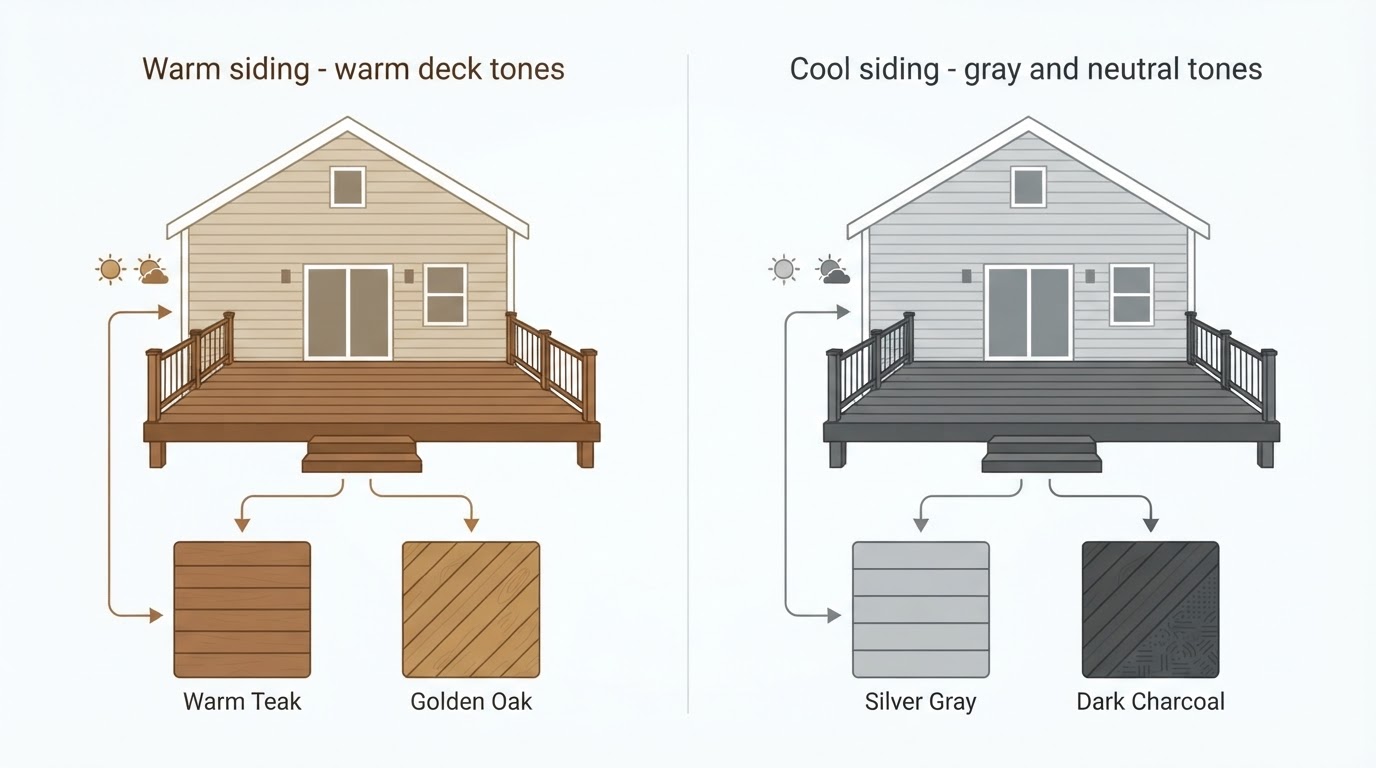
Aesthetics | Grain realism, color consistency, and how the finish weathers | Can I see a full board in daylight instead of a phone photo? |
Warranty | Product coverage versus replacement labor, proration, and transferability | What is excluded, and what happens if I sell the house? |
The table is only as good as the board it is applied to, so ask for the series name in writing on the quote. "Composite decking" is a category, not a product, and a vague line item is the easiest place for a three-brand comparison to go sideways.
TimberTech, Trex, and Fiberon each sit behind that table as a family of series, which changes what you should ask:
- With TimberTech, ask which series sits at which tier, how the board surface is capped, and how the warranty changes with the series.
- With Trex, ask for the exact series name on the quote and compare it with the next tier up; that is where surface feel and warranty terms usually move.
- With Fiberon, ask which series you are looking at, how much color variation the finish carries, and what the surface warranty excludes.
Lifespan and Upkeep: Read the System, Not the Slogan
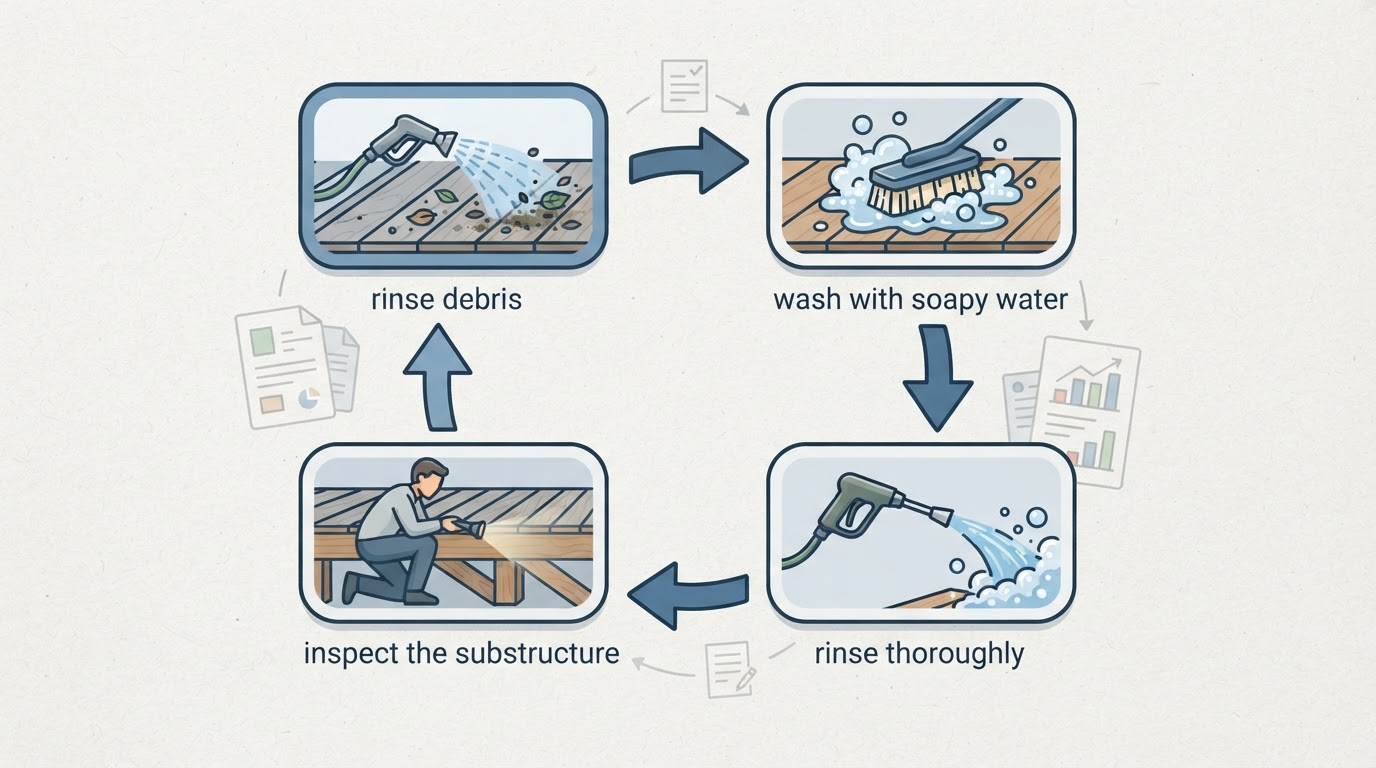
No composite board lives or dies on its own. Lifespan is a system property: the board, the framing, the spacing and ventilation, the fasteners, and the installation details all decide whether the deck is still solid in fifteen years.
That is why "no staining" and "minimal maintenance" are fair descriptions of the composite category but weak guarantees about your specific deck. For most homeowners, low-maintenance means periodic cleaning instead of an annual staining ritual, provided the deck was built with the airflow and framing details the manufacturer specifies. The same board can perform differently on two decks in the same neighborhood, which is why the inspection that happens before the quote can matter as much as the material.
Ask each contractor how the substructure will be ventilated, how the boards will be fastened, and what happens if the framing under an old deck is not what the quote assumed.
Heat and Scratch Resistance: Judge Them in Person
Heat is the surprise complaint, and color is usually the bigger variable. Darker boards absorb more sunlight and hold more warmth on a south- or west-facing deck, and the honest test is not a specification — it is standing on the actual color, on a sunny afternoon, before you commit.
Scratches work the same way. Every composite surface will show something eventually: furniture dragged across a board, a dog's nails, a dropped grill lid. The useful question is how visible those marks are on the finish you are considering and how much work it takes to make them less obvious.
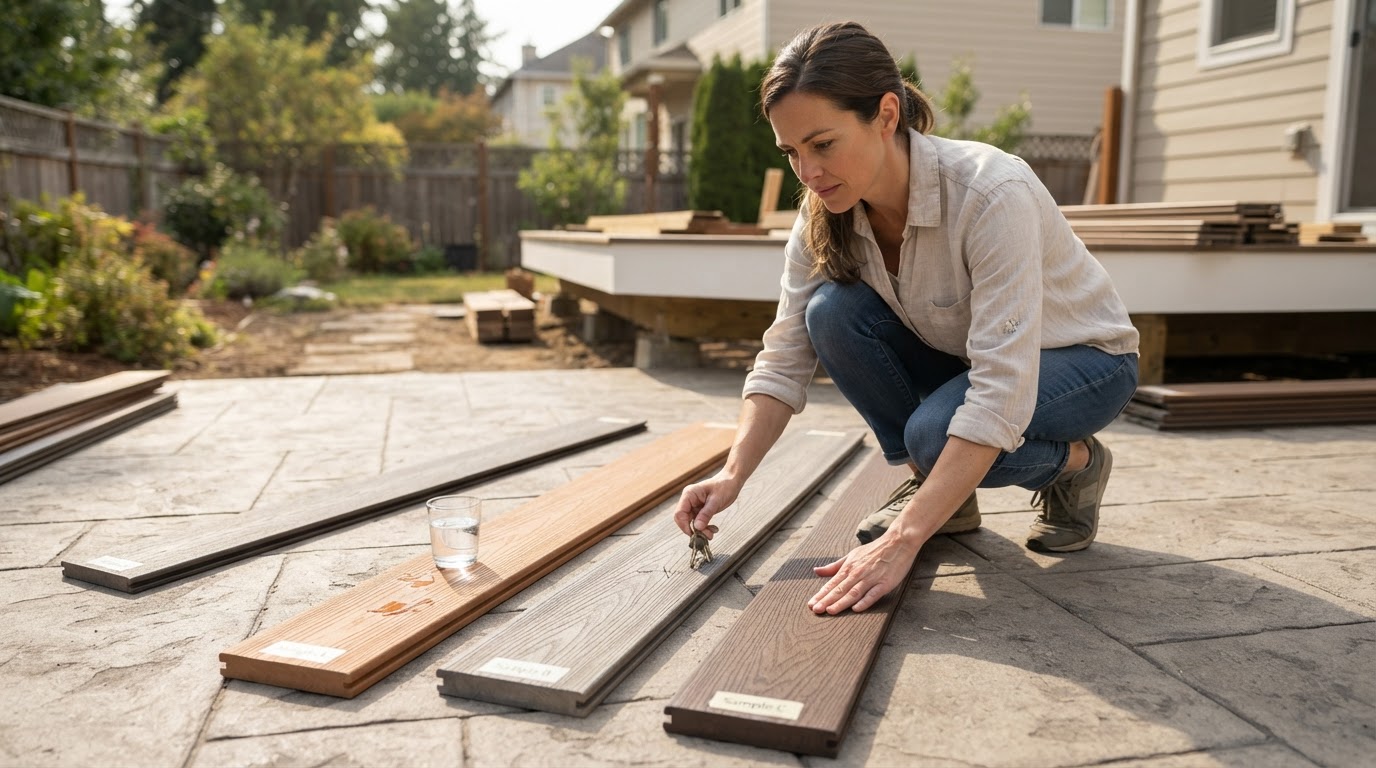
Ask for a loose sample board, take it outside, and spend five minutes with it. Stand on it in the sun, run a key and a set of car keys across a corner, pour a little water on it, and look at it at an angle in daylight. No marketing photograph survives that test as well as a sample does.
Aesthetics: Daylight Beats Showroom Lighting
Composite has closed much of the realism gap with wood, but the differences between lines now live in the details: how the grain repeats, how much color variation a board carries, how the surface catches light, and how the finish settles after a few seasons.
Look at a full-length board whenever possible, and look at it outdoors. Ask to see a recently finished local project in the color family you are considering; a real deck that has been through two summers tells you more about fade and dirt than any showroom display. Apply the same three tests to all three brands — full board, daylight, installed deck — and your comparison will be apples to apples.
How to Read a Composite Decking Warranty
The warranty is where the three brands diverge most on paper, and where the fine print decides the real outcome. Read it in this order.
- Product coverage versus labor coverage. The headline number is usually the product warranty — the board itself. What you feel as a homeowner is labor: removal and replacement. Check whether labor is covered, for how long, and by whom.
- Prorated versus non-prorated. A 25-year warranty is not usually 25 years of full replacement. Many warranties step down over time, so a claim in year 18 may be covered at a fraction of value.
- Transferability. If you may sell the house, check whether coverage transfers and whether there is a fee or a notice window.
- Exclusions. Fade limits, stains, scratches, ventilation requirements, and installation errors are the usual pressure points. Ask specifically what voids the surface warranty.
- Who files a claim. Know whether you call the manufacturer, the contractor, or both, and get the answer in writing before you sign.
This is one place where a certified installer changes the arithmetic. Deck Bros is a certified TimberTech Platinum Contractor, and that Platinum status adds 5 to 7 years of replacement labor coverage on top of a 25-year product warranty on qualifying projects — the kind of product-versus-labor gap that most quotes never explain.
Questions to Bring to Every Estimate
Bring the same questions to each contractor, and compare the answers the same way you compare boards.
- Which exact series is this quote for, and what is one tier up and one tier down?
- What is the product warranty length, and what is the labor or replacement warranty length?
- Is the warranty prorated, and does it transfer if I sell the house?
- Which surface issues, such as stains, scratches, and fade, are excluded?
- How will the deck be ventilated, and what framing and fastener details keep the warranty valid?
- Who pulls the permit, and who inspects the substructure on a resurfacing project?
- Can I read the full manufacturer warranty before I sign?
- Can you show me a local deck in this color that has been installed for at least two seasons?
- What is included in the itemized price, and what is excluded?
Where Deck Bros Fits
Deck Bros installs composite decking from TimberTech, Trex, and Fiberon, which means you can see all three manufacturers' boards in one conversation instead of driving between showrooms that each carry one line. The company offers end-to-end in-home design consultations and handles custom composite builds as well as new decking over existing structures, so the material questions get settled before the first board is ordered.

Deck Design landing featuring in-home design consultation, material samples, accessibility-conscious design options. Useful for deck design process articles.
Deck Bros publishes itemized composite projects in roughly the $16,000 to $65,500 range instead of a single per-square-foot number. That range is a more useful benchmark than a rule of thumb, because it reflects the variables that should appear on any quote: deck size, railing, and board tier.
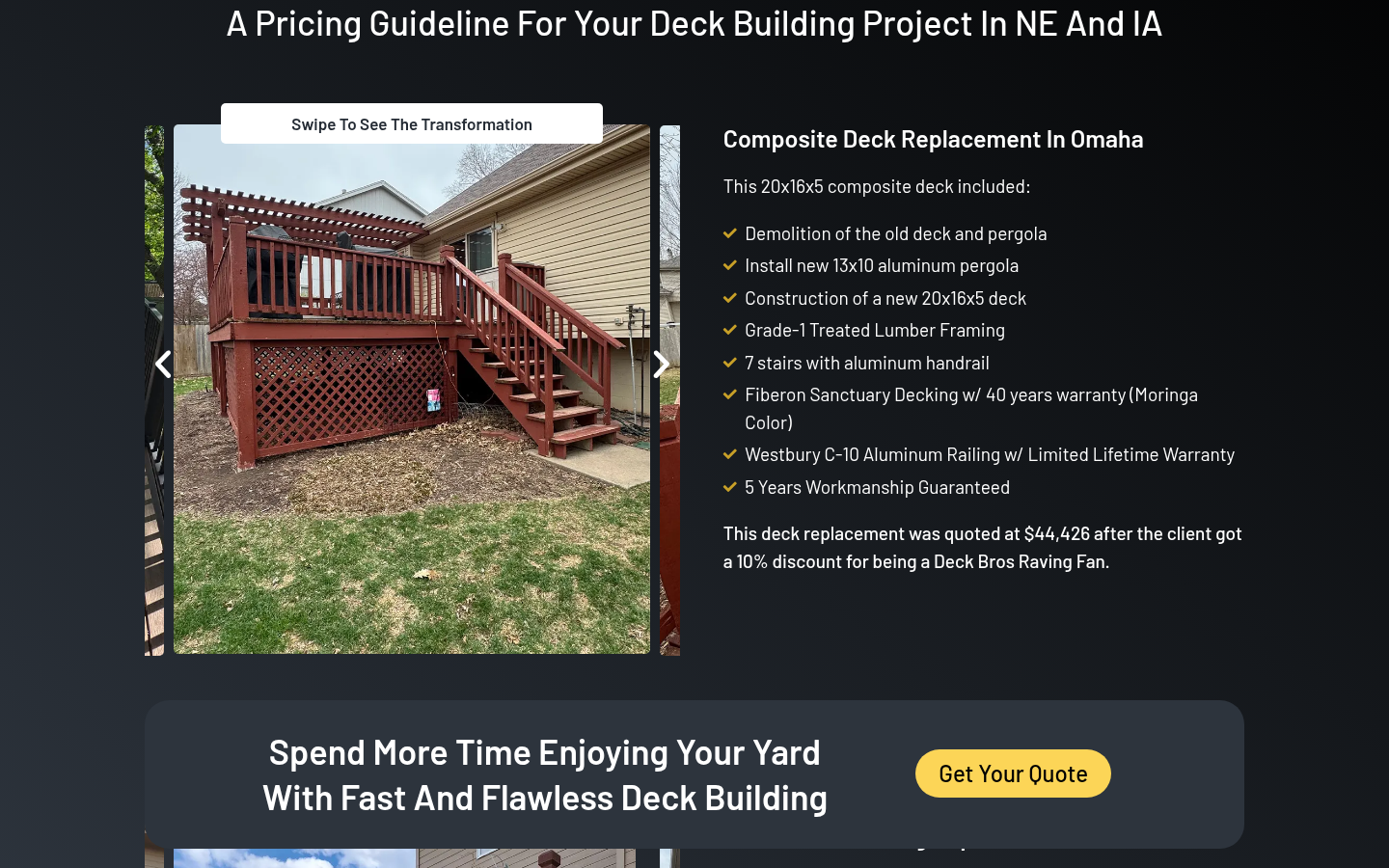
Mid-page pricing section with real case study: composite deck replacement at $44,426 (20x16x5, Fiberon Sanctuary, Westbury railing). Ideal for composite vs wood cost articles.
If your old wood deck has reached the point where patching no longer makes sense, the practical next step is a consultation. Bring the series shortlist and the warranty questions above; the goal is to leave with a written specification, a warranty summary, and a quote you can compare line by line.
A Decision Process You Can Finish
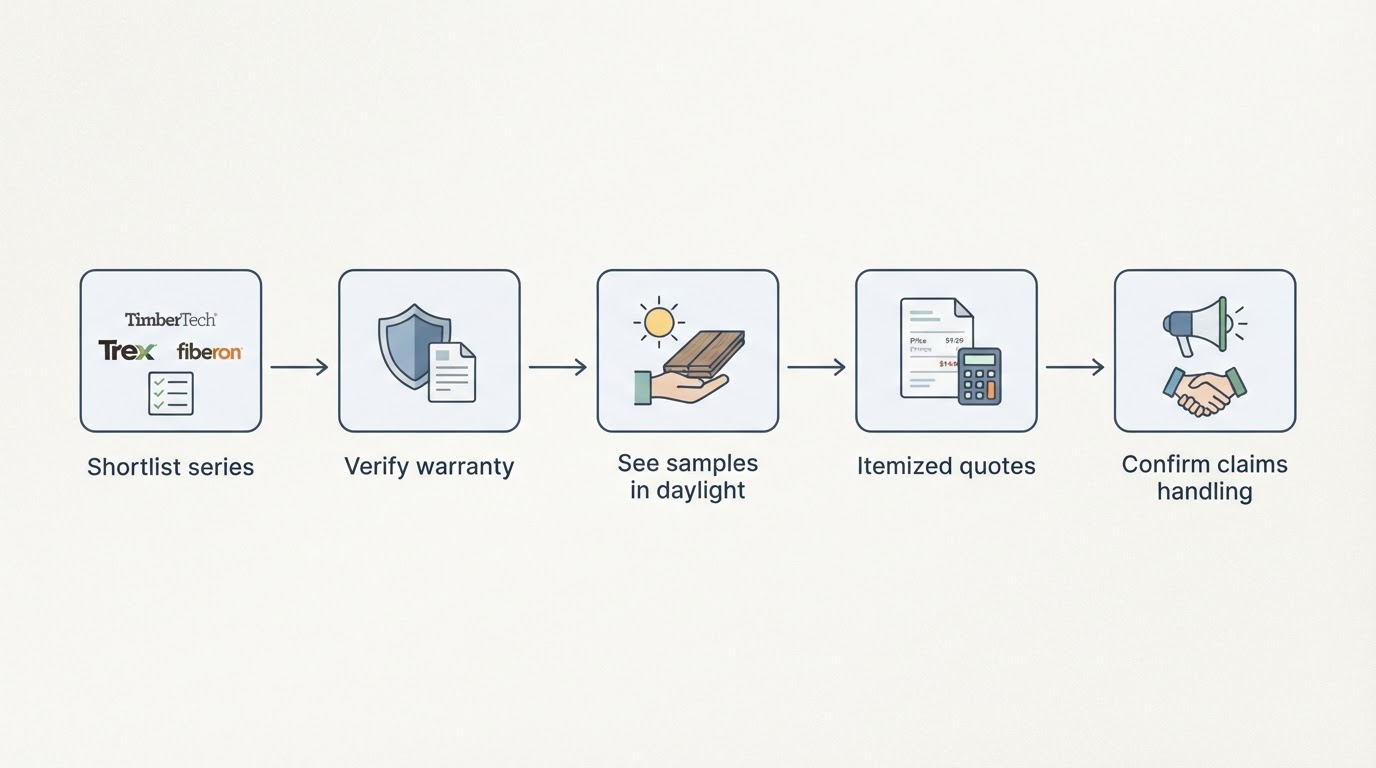
- Shortlist two or three specific series, with the exact names written down.
- Verify the product and labor warranty terms in the actual warranty documents.
- See full-size samples in daylight and test heat and scratch resistance in person.
- Get itemized quotes for the same scope from each contractor you are considering.
- Confirm who handles a claim and where the labor coverage comes from.
You are done with the comparison when you can name the exact series, state its product and labor warranty in one sentence, and point to a written quote that uses those same terms. If any of the three is missing, the comparison is not finished yet, no matter how the boards look.
None of the three brands is the wrong answer for every deck. The wrong answer is choosing by logo and discovering later that the series, the warranty, or the installer's follow-through was never what you assumed.