What composite deck maintenance actually involves
Short answer: routine cleaning, occasional inspection, and no refinishing cycle. Composite decking is designed so you do not have to sand, stain, or seal it on a schedule; what remains is keeping the surface clean and checking that the structure under it stays sound and dry.
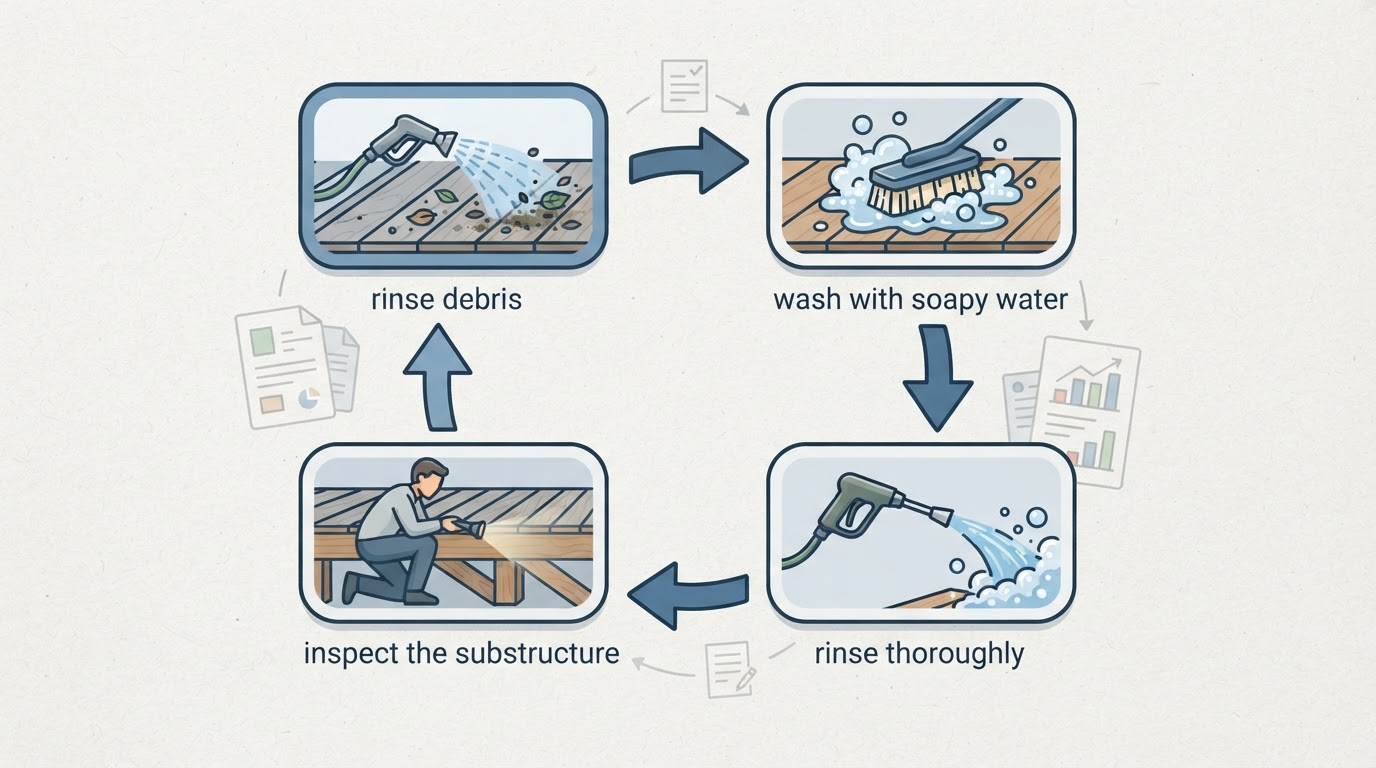
Trex's care and cleaning guide tells owners they never need to worry about sanding, staining, or sealing and that occasional soap-and-water cleaning maintains performance and appearance; the same guide states that sanding is not recommended and voids warranty coverage for conditions it causes. TimberTech's Care & Cleaning Guide frames the remaining work as minimal maintenance apart from regular inspection of the deck substructure to confirm ongoing integrity. Fiberon's maintenance and care page adds the drainage and airflow basics: keep the deck dry and clean, and clean it as often as needed, at least twice each year.
The practical takeaway: composite deck maintenance is a cleaning habit plus an inspection habit. It is not a weekend of scraping and resealing every spring.
Key answers at a glance
Quick answers first — composite deck upkeep is lighter than wood, but it is not zero-effort. Each item below stands on its own; the sections that follow go deeper where it matters.
- How often should you clean a composite deck? As needed — Fiberon gives at least twice a year as a baseline, and that schedule keeps pollen and organic debris from settling into board gaps.
- Do composite decks need sealing or staining? No. Trex treats occasional soap-and-water cleaning as the routine, and sanding is not recommended.
- Is a pressure washer safe? Only inside your brand's published limits — up to 3,100 psi on Trex high-performance lines, rinsing only at up to 1,500 psi on TimberTech, and under 3,000 psi on Fiberon.
- Which cleaner should you use? The one your manufacturer approves. TimberTech warns against products marketed as composite deck cleaners on current collections, and Trex warns that bleach- or acid-containing products lighten boards.
- What discolors a composite deck? Rubber-backed mats, tarps, pool toys, and other nonporous items left in place, because they trap moisture against the boards.
- How fast should spills be cleaned? As soon as possible. Trex requires cleaning within seven days to maintain its stain warranty.
- Can poor care affect the warranty? Yes — published care instructions are conditions of coverage.
How to clean a composite deck safely
Short answer: use warm soapy water and a soft-bristle brush, work in small sections, rinse thoroughly, and skip cleaning in direct sunlight.
The manufacturers agree closely on the basics. Trex's care guide specifies warm soapy water with a soft-bristle brush for dirt and debris. TimberTech's guide adds three practical rules: clean in small sections, rinse thoroughly, and avoid cleaning in direct sunlight; it also recommends a medium-stiffness nylon brush for composite boards rather than a stiff natural-fiber brush.
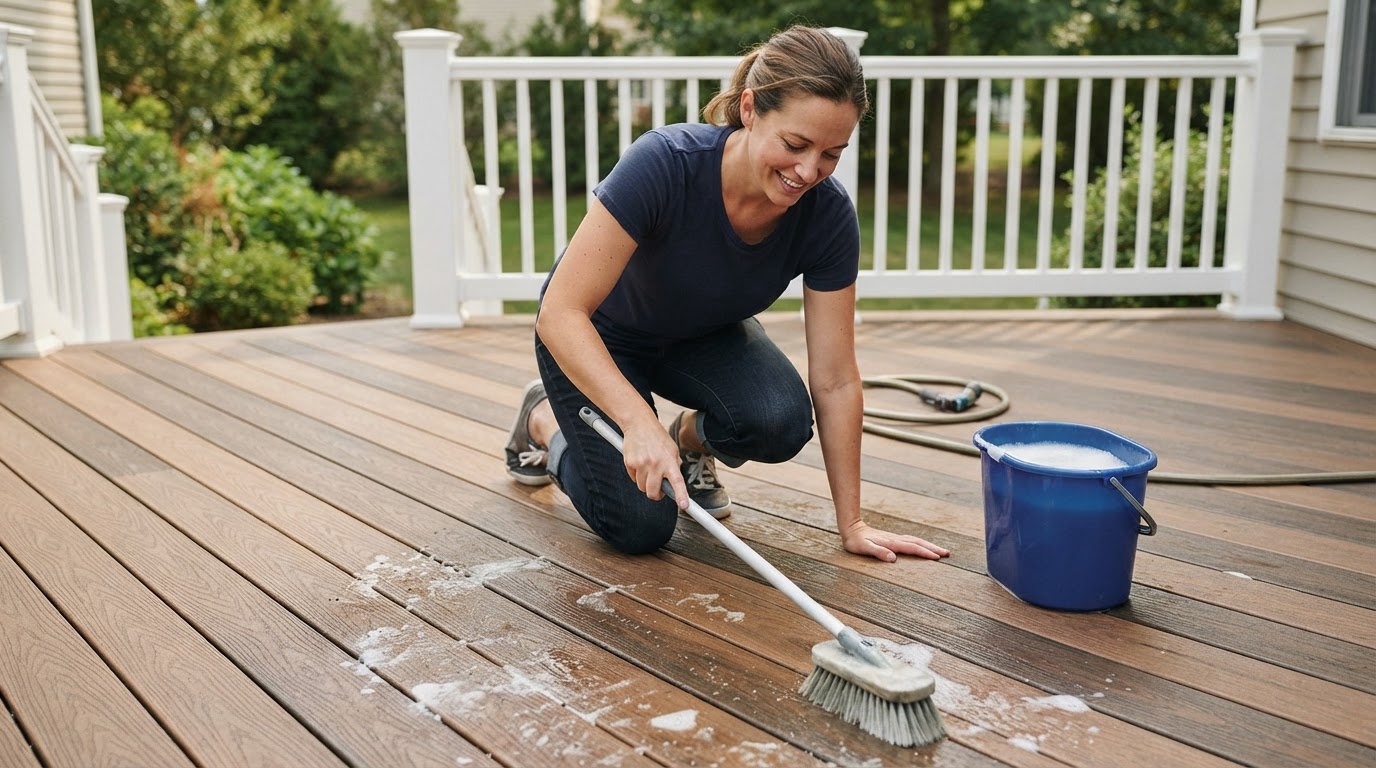
A garden hose is usually enough. Pressure washing is a rinsing tool at most, and only within limits set per brand and product line. Two cleanings a year is a reasonable floor: Fiberon recommends cleaning at least twice each year, and Trex describes semi-annual cleaning as a way to prevent mold while calling for semi-annual cleaning with a composite deck cleaner on its early-generation boards.
Cleaners: follow the product list, not the store shelf
Short answer: use only the cleaner your manufacturer approves for your specific product line, because compatibility is product-specific.
That warning is not generic. TimberTech's care guide states that products marketed as composite deck cleaners should not be used on its current composite and Advanced PVC collections, and it recommends warm water with a nonabrasive, pH-neutral detergent (pH 5–8) or its own approved cleaner instead. Trex's care guide notes that bleach- or acid-containing products will lighten the board surface, and Fiberon directs owners to its capped composite care documents for product-specific instructions.
The practical rule: before any bottle touches the deck, find your board's care document and check the approved list. Household substitutes vary too much in strength and chemistry to treat as safe defaults.
Pressure washing: exact limits by brand
Short answer: pressure washing is allowed only within limits that differ by manufacturer and product line, and exceeding them risks board damage and warranty coverage.
Manufacturer | Published limit | Notes |
|---|---|---|
Trex | Up to 3,100 psi, fan tip no closer than 8 in. | For high-performance lines (Transcend, Enhance, Select). Not recommended on early-generation boards, and voids warranty coverage for conditions it causes there. |
TimberTech | Up to 1,500 psi, fan tip, rinsing only | A garden hose is sufficient for routine cleaning. |
Fiberon | Under 3,000 psi, 10 in. above the surface | Use extreme caution and wash in the direction of the grain. |
Two rules sit under those numbers. First, use a fan tip rather than a pinpoint nozzle — Trex and TimberTech both specify fan tips. Second, keep the wand at the distance your brand requires. Trex warns that pressure above its stated limit can damage boards and void warranty coverage, and Fiberon and TimberTech frame their limits the same way.
What stains or discolors a composite deck
Short answer: trapped moisture and prolonged contact, not normal rain. Rubber-backed mats, tarps, pool toys, planters, and other nonporous items are the things to watch.
Manufacturers advise against leaving rubber-backed mats, tarps, pool toys, or other nonporous items on the deck surface for extended periods, because trapped moisture and plasticizers can discolor boards (Trex, TimberTech). Fiberon adds that anything stored on the deck can block evaporation and cause staining, and its care list recommends keeping debris out of the gaps between boards, minimizing wet mulch against the deck, and avoiding wrought iron or other carbon steel materials in contact with or above an uncapped composite deck.
Spills are the other half of the equation. Trex says food spills should be removed as soon as possible and that the surface must be cleaned within seven days to maintain the stain warranty. Keeping the deck dry and clean is the simplest way to stay ahead of both problems.
Snow and ice: what to use and what to skip
Short answer: use a plastic shovel, never a metal one, and check your brand's care document before using any ice-melt product, because guidance differs.
Manufacturers agree on the shovel rule; TimberTech cautions against metal shovels because they risk scratching the surface. Ice melt is where the brands diverge. Trex allows calcium chloride or rock salt. Fiberon recommends calcium chloride-based ice melt or rock salt and says never to use sand or ice melt with added colorant. TimberTech says most calcium chloride products are usable but advises avoiding rock salt and other abrasive ice-melt products.
That split is exactly why the care document matters more than a generic tip: a product that is fine on one brand's boards may be off-limits on another's.
Composite vs. wood: upkeep and lifespan
Short answer: composite removes the refinishing cycle that wood needs, while both materials still need cleaning and inspection; the clearest comparative evidence comes from a manufacturer-commissioned survey, so read it with that context.
Trex's 2026 Wood Regret Survey press release reports findings from an online survey commissioned by Trex and fielded by Atomik Research: 2,000 U.S. single-family homeowners, surveyed March 26–31, 2026, with a margin of error of about ±2 percentage points at 95% confidence. Among the reported results: 78% of wood-deck owners said they regretted their material choice; 43% of wood-deck owners spent more than 10 hours a year on maintenance; 76% spent at least $100 a year; 70% of composite owners said their deck had maintained its appearance over time versus 50% of wood owners; and 82% of composite owners were confident their deck would last 15–20 years with minimal upkeep versus 43% of wood owners. Those are owner perceptions from a survey sponsored by a composite decking manufacturer, not independent performance testing.
Cost estimates follow a similar pattern. Fiberon's care page states that its composite deck carries less than $50 in annual maintenance costs, compared with pressure-treated deck supplies that "add up to hundreds of dollars each year." The page publishes no study methodology, so treat that as a manufacturer estimate rather than a verified figure.
Lifespan is best handled through warranties rather than blanket numbers. Trex states its composite decking is backed by up to 50-year limited warranties, and those warranties carry care conditions.
How care habits affect your warranty
Short answer: the manufacturer's published care instructions are conditions of your coverage, so the care document functions like a contract.
Concrete examples from the care guides: Trex requires food spills to be cleaned within seven days to maintain its stain warranty and reports that sanding is not recommended and voids warranty coverage for conditions it causes. Trex also warns that pressure above 3,100 psi can damage boards and void warranty coverage, and its instructions do not recommend pressure washing early-generation boards. TimberTech states that cleaners marketed for composite decking should not be used on current collections. Fiberon ties pressure limits and ice-melt choices to its care list.
One more reason to keep your document handy: care instructions are keyed to product generations and collections, and manufacturers retire lines over time. Guidance can go stale as those collections change, so the current document for your exact board — not a general internet tip — is the one that governs.
When maintenance isn't enough
Short answer: cleaning and inspection handle surface upkeep; structural problems need professional attention.
TimberTech frames inspection of the substructure as the part of the job that keeps a deck sound, and Fiberon focuses on drainage and airflow under the deck for the same reason. When those checks turn up a problem — a deck that is no longer solid, rails that need more than cleaning, or boards that are due to be replaced — that is repair or replacement work, not a cleaning problem.
If you are weighing that next step in the Omaha area, Deck Bros is a family-owned deck contractor serving the Omaha metro, Lincoln, and nearby Western Iowa communities. The company builds custom wood and composite decks, replaces decking on existing structures, repairs decks, and offers in-home design consultations. Deck Bros says it is a certified TimberTech Platinum Contractor, a designation it ties to a 25-year product warranty plus an additional 5–7 years of replacement labor coverage, and it installs composite decking from TimberTech, Trex, and Fiberon. When care stops being enough, a local inspection is the practical way to decide between repair and replacement.

Deck Repair landing page hero section showing repair services (stairs, railing, resurfacing, painting, staining) and call-to-action.
Composite deck maintenance FAQ
The short versions: clean as needed, skip the sealer, respect your brand's pressure limits, and treat the care document as part of the warranty.
How often should a composite deck be cleaned?
As needed, with twice-yearly cleaning as a common baseline. Fiberon recommends cleaning at least twice each year, while Trex describes semi-annual cleaning as a way to prevent mold and calls for semi-annual cleaning with a composite deck cleaner on its early-generation boards.
Do composite decks need to be sealed or stained?
No. Trex states that composite deck owners never need to worry about sanding, staining, or sealing, and that occasional soap-and-water cleaning maintains performance and appearance. Sanding is not recommended and voids warranty coverage for conditions it causes.
Can you use a pressure washer on a composite deck?
Yes, within your brand's limits — Trex allows up to 3,100 psi with a fan tip held at least 8 inches away on its high-performance lines, TimberTech allows rinsing only at up to 1,500 psi, and Fiberon says to use extreme caution under 3,000 psi with the wand 10 inches above the surface.
What is the best cleaner for composite decking?
Whatever your manufacturer approves for your exact product line. TimberTech warns against cleaners marketed for composite decking on current collections and recommends a nonabrasive, pH-neutral detergent, while Trex warns that bleach- or acid-containing products will lighten boards. There is no single safe cleaner across every brand.
Does pressure washing void a composite deck warranty?
It can. Manufacturers tie coverage to their published limits: exceeding the stated pressure, tip, or distance risks board damage and void coverage for the resulting conditions, and pressure washing is not recommended at all on certain early-generation boards.
How long does composite decking last?
Warranty terms vary by brand and product line — Trex, for example, states its composite decking is backed by up to 50-year limited warranties — and the care instructions are conditions of that coverage. In Trex's 2026 survey of 2,000 U.S. homeowners, 82% of composite deck owners said they were confident their deck would last 15–20 years with minimal upkeep, but that is a perception finding from a manufacturer-commissioned survey rather than a measured service life.