Why Composite Color Feels Different From Choosing a Wood Stain
If you have maintained a wood deck for years, the color decision changes character when you move to composite. Wood color is something you can revisit: sand and re-stain, and the deck takes on a new look. Composite color is manufactured into the board. You choose it once, at the beginning, and live with it until the deck is replaced.
That shift moves the goal from "what looks good this summer" to "what will still look right in ten years." Independent contractor-editorial guidance draws the distinction plainly: ultra-dark, uniform tones often look dramatic when new but can read as tired by year seven or eight as fading turns uneven, while mid-tone colors with natural wood-grain variation and streaking tend to absorb visual wear more gracefully across a 10–15 year horizon (House and Deck Color Combinations That Actually Work).
The practical consequence is timing. On a wood deck, a color you dislike is a maintenance problem you can fix later. On a composite deck, it is a board-order problem you cannot fix without replacing boards. That is why the aesthetic conversation belongs early, before the material is ordered rather than after the frame is built.
How Composite Color Families Differ
Composite decking colors are commonly grouped into a handful of families: warm browns, cool grays, neutral tan and beige tones, plus red and earthy options and multi-tonal boards that streak light and dark within a single board. The important caveat is that each manufacturer defines and names its own families, so a family label is brand-specific rather than universal (TimberTech sample guidance, Trex color families).
Color family | Aesthetic association from manufacturer guidance |
|---|---|
Brown | Traditional and rustic settings |
Gray | Coastal, contemporary, southern, and farmhouse styles |
Tan, blond, and neutral | Contemporary, mid-century modern, and Scandi-chic settings |
Red and earthy | Rustic, mountain, and craftsman homes |
Multi-tonal streaked boards | Variation that reads differently across a deck |
The same guidance notes that brown ranges from deep woodland tones to golden amber, gray covers both silver and stormy shades, and tan leans sunny and sandy (TimberTech). What matters for choosing is not the marketing name but the direction of the family: warm, cool, neutral, or earthy. A shade name only means something inside its own brand's palette, so compare families first and names second.
Undertones: The Step That Decides Whether It Looks Right
Undertone is the cast beneath a color: the blue or green under a gray, the yellow or red under a beige. It is the reason two browns can look wrong and right against the same wall.
Independent guidance maps the pairing this way: warm siding — beige, tan, cream — generally pairs with warm deck tones, while cool siding — gray, charcoal, white, blue-gray — tends to work with gray and neutral families. Gray exteriors need one extra step, because gray spans both warm and cool, so you have to identify the siding's own undertone before choosing a board family (Heritage Deck).
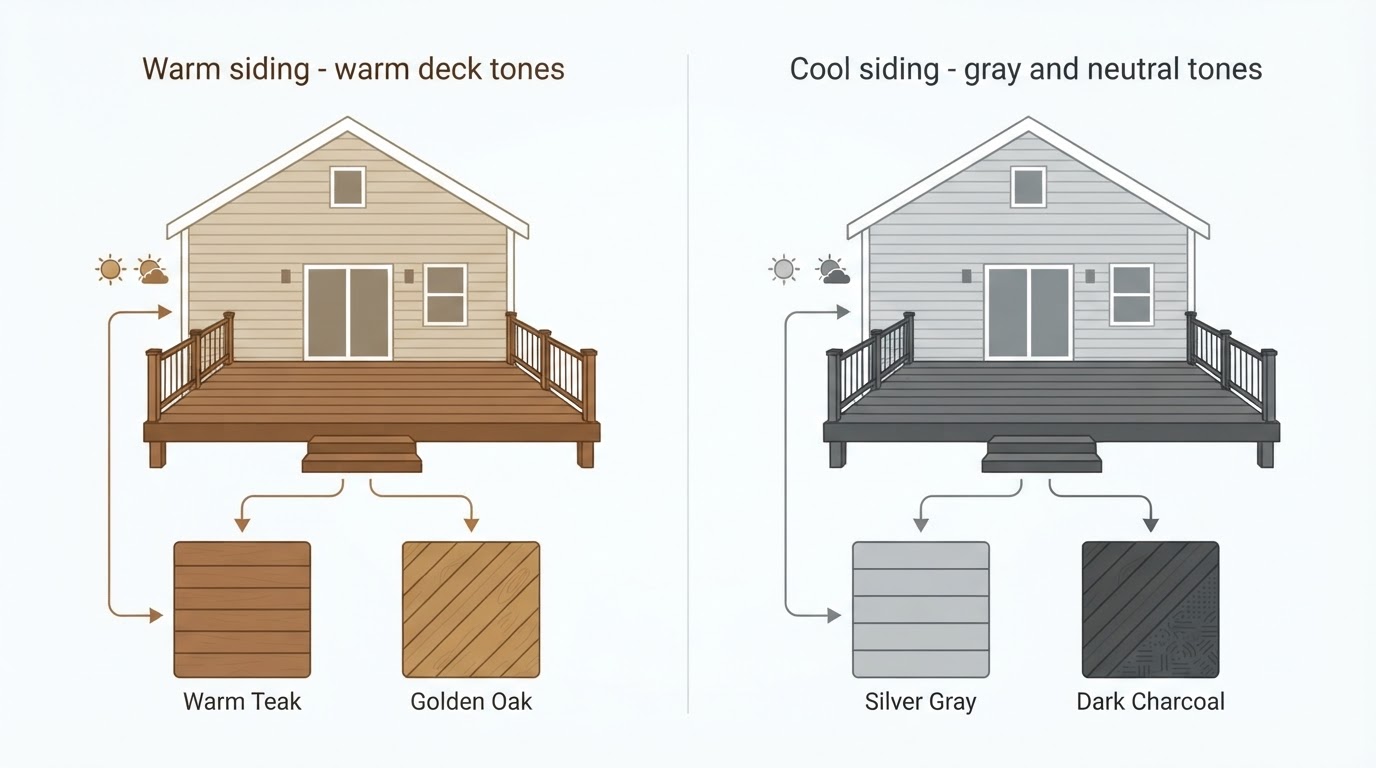
You do not need a color-theory lesson to apply this. Stand where you will walk onto the deck most often, hold a sample board against the fixed surfaces you cannot change — siding, trim, brick, stone, roofline — and ask one question: does the board look like it belongs, or does it look slightly off in a way you cannot name? The unnameable "off" is usually two undertones fighting. A board that belongs will look quieter than a board that merely looks nice on its own.
Coordinating the Deck With the House
The most common coordination mistake is matching the deck boards as closely as possible to the siding. Guidance from contractor-editorial sources says that approach tends to read flat and undefined, and that either deliberate contrast or a connection built through trim is more reliable, with the amount of contrast scaled to the deck's size and height (Heritage Deck).
Three moves do most of the work:
- Fascia as a bridge. Matching the fascia to the window and door trim ties the deck to the house instead of leaving it sitting beside the house.
- Railing as a transition. Black railings read as a bridge between a dark deck and a light house; white railings bridge a light deck and medium siding.
- Contrast scaled to the space. On a large or elevated deck, stronger contrast reads as intentional; on a small deck, the same contrast can overwhelm the space. The goal is a deck that looks composed from the street and from the kitchen window.
If you want the safest result, choose the deck within the same warm or cool direction as the siding, then create interest with trim, fascia, and railing rather than with a large tonal jump.
Sun, Shade, and Heat: The Trade-offs Most Color Charts Skip
This is where color stops being purely visual, and it is the part of the decision that most charts leave out.
- Heat. Manufacturer guidance states that all decking gets hot in the sun, that darker colors feel hotter than lighter ones, and that lighter colors are the recommendation for hotter climates (TimberTech).
- Shade and debris. In yards with mature tree canopy, light-colored decking can visibly collect pollen, mold, and organic debris (Heritage Deck).
- Fade. Dark decking in full sun absorbs heat and can fade unevenly over time (Heritage Deck).
Read together, those three points give a workable rule. A south- or west-facing deck in full sun leans toward lighter and mid-tone boards that stay cooler and fade more evenly. A heavily shaded deck often looks better in mid-tones than in near-white or near-black boards: pale boards advertise every bit of pollen, and very dark boards can look heavy in low light.
How to Order and Test Samples Before You Commit
Reliable color selection requires physical samples evaluated in the deck's real conditions — held vertically against the siding rather than flat on a table, and viewed at morning, midday, and dusk, because the same board reads differently in each light (Heritage Deck, Trex).
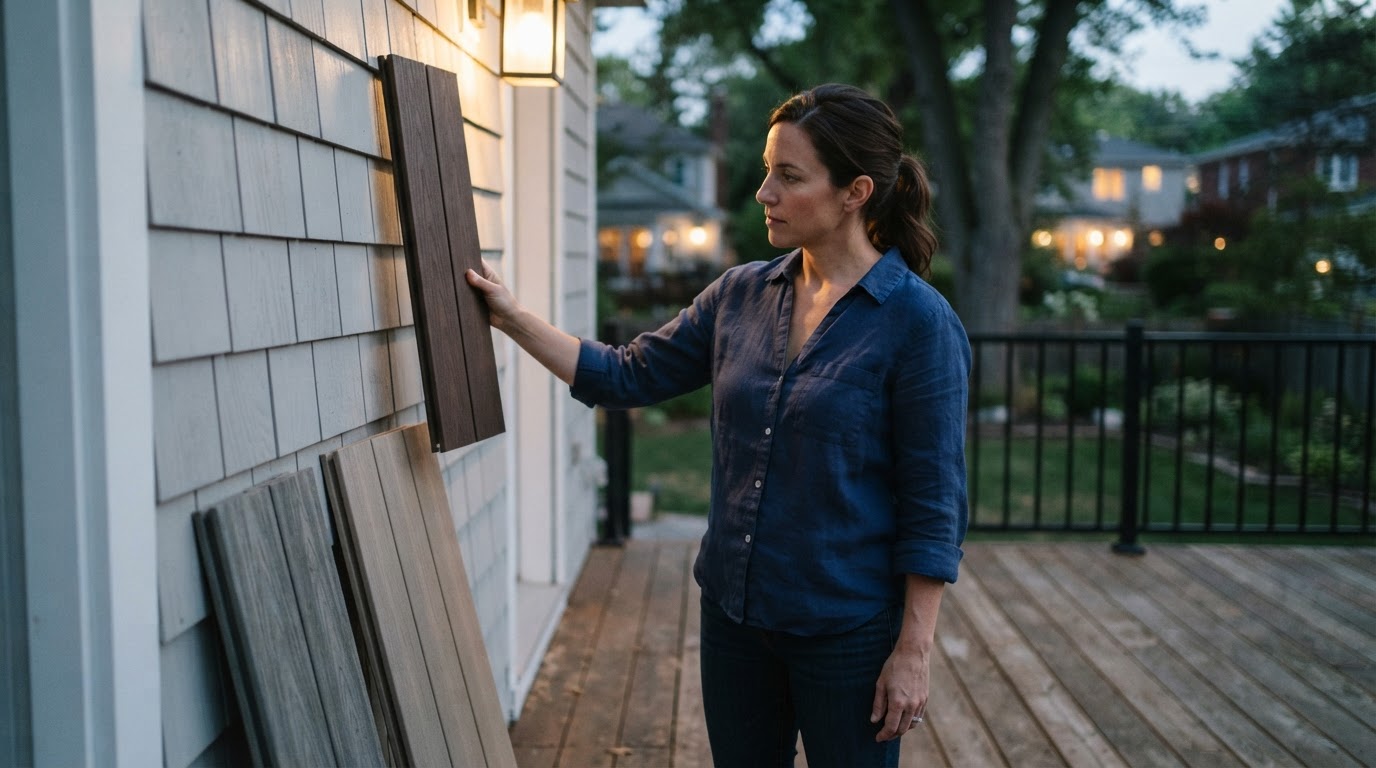
A sample routine that catches most mistakes:
- Order samples from the brand or brands you are considering. TimberTech's sample program caps an order at four boards (TimberTech), enough to test a primary color, a contrasting border or trim tone, and a railing pairing.
- Hold each board vertically against the siding in the actual location, not flat on a table or against a garage wall.
- Look at the samples three times in one day, and repeat on a gray day if you can.
- Check the boards against the interior flooring at the door threshold; that transition is where a mismatch shows up first.
- Leave the samples in place for a few days and see which board you stop noticing. The one that becomes background is usually the right choice.
Order samples as early as you can. Waiting until the material order is pending removes your ability to change direction without cost or delay.
A Selection Sequence You Can Finish in One Weekend
- Inventory the fixed colors. Photograph the siding, trim, roof, brick or stone, and window frames at midday.
- Name the undertone of the siding. Warm, cool, or neutral. If it is gray, look again, because gray runs both directions.
- Choose a coordination strategy. Deliberate contrast, or a trim-and-fascia connection that ties the deck to the house.
- Order samples and run the three-light test in the real location, against the real surfaces.
- Check the sun-and-shade trade-off for your specific deck: heat and fade on a full-sun exposure, debris visibility in deep shade.
If two options still feel equally right after those steps, that is a good sign rather than a problem. It usually means both will age acceptably, and the decision can rest on practical grounds: which railing pairing looks better, or which board looks calmer at the door where you will see it every day.
Where a Local Contractor Fits Into the Color Decision
Nothing above requires a contractor, but one part of the process is genuinely easier in person: getting the right samples onto your siding, at your times of day, and reading them against the exterior as a whole. That is the work a design consultation is built around.
Deck Bros is a family-owned deck contractor serving the Omaha metro, the Lincoln area, nearby Nebraska towns, and Western Iowa, building custom wood and composite decks and installing new decking over existing structures. The company says its in-home design consultations bring physical material samples and work through the pros and cons of each product and color, with design, planning, permitting, and construction handled end to end.

Deck Design landing featuring in-home design consultation, material samples, accessibility-conscious design options. Useful for deck design process articles.
For a homeowner replacing an aging wood deck, that consultation is where the steps above happen against your actual exterior, before any boards are ordered. If you would like to walk through composite decking color options with samples in hand, book a design consultation with Deck Bros.