Rot or Wear? Read the Symptoms Before You Panic
Most of what looks alarming on an older deck is ordinary weathering. Ultraviolet light bleaches wood to silver-gray. Thin cracks that run along the grain — called checking — appear as boards dry out season after season. Mildew leaves a dark, powdery film, and tannins or rust from fasteners can stain the surface. None of that weakens the structure, and most of it cleans up or finishes over.
Rot is different in kind, not just in degree. Decay fungi need wood and moisture, and they digest the fibers that give a board its strength. The result feels soft, spongy, or crumbly rather than merely weathered. The practical test is a probe: push the tip of a screwdriver or an awl into the suspicious area. Sound wood resists and the tool tip leaves a small dent. Decayed wood gives way, and the tool sinks in with little resistance.
Where you probe matters as much as how. Water collects at board ends, around and under fastener heads, where boards meet the rim or the house, around posts, and under planters, steps, and downspouts. A board can look perfect across its middle and be hollow at both ends. It also pays to compare: probe a board you know is sound, then probe the suspect one. The difference in resistance tells you more than color ever will.

One complication worth knowing: insects can produce symptoms that look like rot. Carpenter ants and termites hollow out wood and leave it weak, sometimes with mud or frass nearby. Either way the next step is the same — find out how far the damage goes before you decide what to do about it.
A Safe Walkthrough You Can Do in an Afternoon
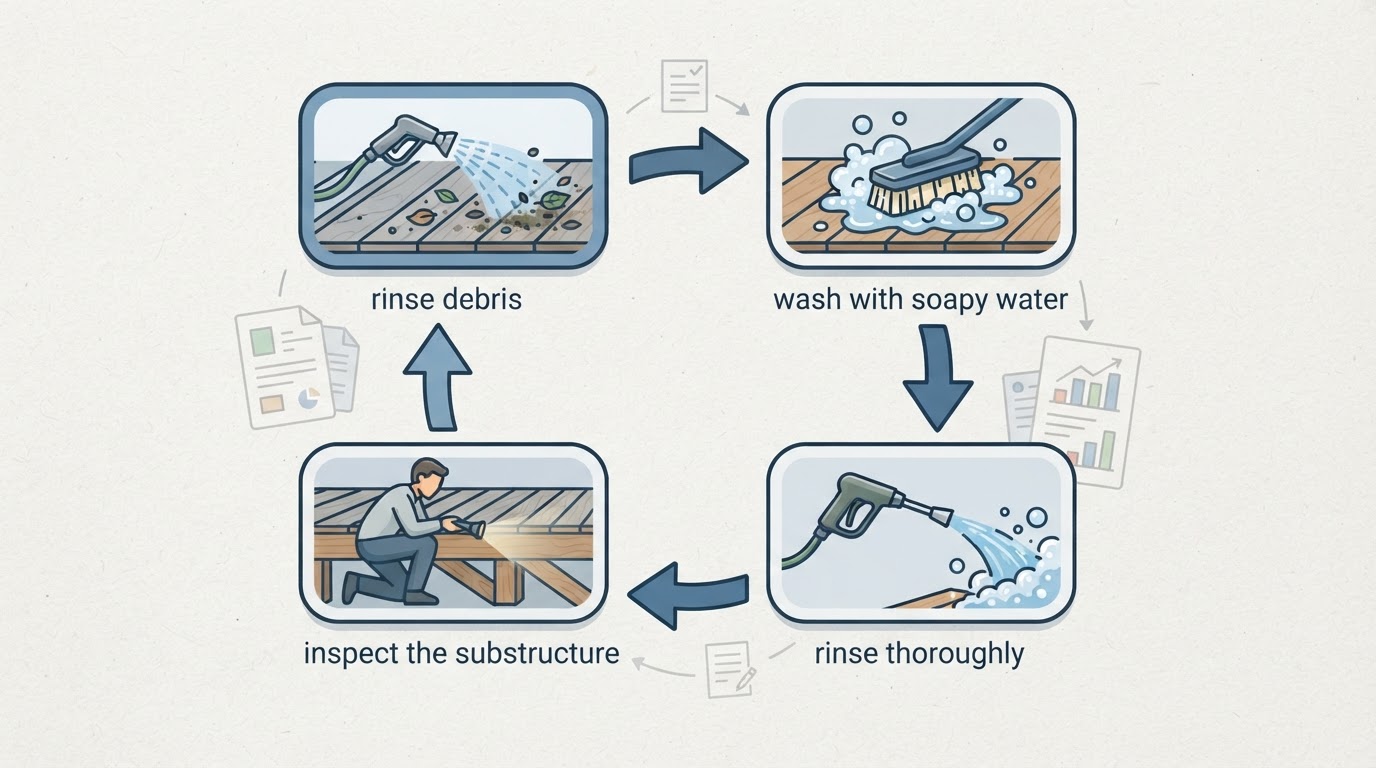
You do not need to diagnose the deck yourself. The goal is narrower and more useful: collect evidence about which parts flex, crunch, or stay wet, and where. Set aside a screwdriver or awl, a flashlight, and a notebook or phone for photos, then work through the deck in one pass — ideally after a rain, when moisture problems show themselves.
- Walk the surface. Note dark, soft-looking spots along the paths people actually use, plus any section that feels bouncy or springy underfoot.
- Probe the suspects. Use the screwdriver test at board ends, along fastener lines, and at any spot that looks stained or feels different from its neighbors.
- Test the railings. Push them side to side and up and down. A slightly loose baluster is minor; movement at the post base or where the railing meets the deck is not.
- Check the stairs. Look for treads that rock, stringers that feel soft, and handrails whose anchors have pulled. Stairs are often the first failure point because water sits on them and air moves around them less.
- Observe the ledger and flashing. The ledger is the board that attaches the deck to the house, and it is the most moisture-prone connection in the whole structure. If the deck feels unstable, inspect it from a distance rather than crawling under it.
- Inspect posts and footings. Wood that meets soil or concrete can wick water upward. Probe just above the ground line and watch for any post that shifts.
- Look underneath, if it is safe to do so. From a protected position, check joists, beams, and hangers for staining, fungal growth, sagging, or loose connections.
Your completion standard is a short written list: each problem spot, what you found, and how it responded to the probe. Add photos and dates. That list is exactly what a contractor needs to give you an accurate scope instead of a vague range — and it gives you a baseline to compare against in a year.
A safety note that overrides the checklist: do not crawl under a deck that moves, do not test questionable boards with your body weight, and stop using any area where a railing, stair, or post shifts more than slightly.
Cosmetic, Isolated, or Structural? A Simple Triage
What you find | What it usually means | First move |
|---|---|---|
Gray, checked boards with solid wood under the surface; mildew film | Cosmetic weathering | Clean and finish sound wood; redirect water away from the deck |
One or two soft boards near a planter, step, or downspout | Localized decay with a moisture source | Fix the water source, replace the boards, and monitor the framing |
Crumbling board ends in several areas; fasteners that no longer hold | Moisture is reaching deeper than the surface | Have the framing inspected before covering it with new decking |
Soft joists, beams, or ledger; sagging or springy sections; moving posts or stair stringers | Structural decay | Limit access and arrange a professional evaluation |
The table is a starting point, not a verdict. Rot rarely stays where you first notice it. Water wicks along board ends, travels through joists, and sits behind flashing, so the one soft board you can see may be the visible edge of damage that started somewhere else. Treat every visible symptom as a question about what is happening behind and below it.
Repair or Replace? Three Questions That Decide It
When a deck has rotting deck boards, the repair-or-replace decision comes down to three questions: How much of the deck is affected? Is the framing sound? Will the fix last?

Repair usually makes sense when the decay is limited to a handful of boards or a single corner, the joists, beams, ledger, and posts still test sound, and the water problem that caused the rot can be fixed. Replacing a few boards is a reasonable, targeted job — provided someone has confirmed what is underneath them.
Replacement becomes the better answer when rot has reached joists, beams, the ledger, or the posts and footings; when the same areas keep failing; when sections sag or move; or when the deck is old enough that repairs are becoming a recurring expense. At that point new boards over a failing structure are a temporary fix, not a solution.
Resurfacing is the middle path. Installing new decking over an existing structure can be a sensible option when the frame is verified sound — it addresses worn boards without the cost of a rebuild. The order matters: inspection first, decking second. New boards installed over softening framing hide the problem and make the next repair more expensive.
That is the trade-off to keep in mind. The cheapest-looking decision — replacing only the boards you can see and painting over the rest — is the one most likely to cost more later, because the moisture source and the decay behind it are still there.
While You Decide: Small Steps That Protect the Deck
- Keep heavy loads — grills, planters, hot tubs — off sections you have flagged.
- Mark or block off any area with a shifting railing, stair, or post.
- Fix the water: clean gutters, extend downspouts away from the deck, correct ponding, and keep soil from mounding above footings.
- Do not paint or stain over soft or crumbling wood. Finish protects sound wood; it does not stop decay, and it hides how far the damage has spread.
- Write down what you found and when. A simple log makes it easier to compare estimates and to tell whether a problem is stable or growing.
When to Bring In a Professional Assessment
Homeowners can spot a lot from the surface, but some of the most important parts of a deck are the ones you cannot see or safely reach: the ledger connection and its flashing, joist hangers, post bases, and the framing below the decking. If your walkthrough turned up soft boards in more than one area, movement in a railing or stair, or anything you could not verify safely, it is time to get eyes on the structure. A professional assessment answers the question that actually matters: can this deck be repaired, and is it safe to use while you decide?
That is the situation Deck Bros is set up for. Deck Bros is a family-owned residential deck contractor serving the Omaha metro, the Lincoln area, nearby Nebraska towns, and Western Iowa, with deck repair as well as custom wood and composite deck building, new decking over existing structures, and in-home design consultations. Its repair service includes a free on-site condition assessment and a safety evaluation that tells you whether the deck is still safe to use, along with guidance on whether to repair or rebuild. The company says it has repaired more than 300 decks in the Omaha metro, and the same assessment that answers your safety question also produces the scope you would need for a repair — or the honest answer that it is time to rebuild.

Deck Repair landing page hero section showing repair services (stairs, railing, resurfacing, painting, staining) and call-to-action.
Common Follow-Up Questions
Can rotting deck boards be repaired, or do they always mean replacement?
Not always. If the damage is limited to boards and the framing underneath is sound, replacing the affected boards can restore the deck for years. Decay that has reached joists, beams, the ledger, or the posts changes the math, because the repair now involves the structure that carries the load.
Is a soft spot always rot?
Not necessarily. A soft-feeling spot can come from a cracked board, a thin worn section, or a fastener that has failed and let boards work loose. The probe test is what separates the cases: sound wood resists a screwdriver, while decayed wood gives way.
Can I just replace the boards and keep the frame?
Only after the frame has been checked. It is common for a surface-only job to grow once the old decking comes off and the joists are visible. Plan for that possibility, and ask whoever does the work to inspect the framing before quoting a final scope.
Does painting or staining stop rot?
No. A finish slows moisture movement into sound wood, but it does not kill decay fungi or restore strength, and coating soft or dark wood traps moisture and hides the extent of the damage. Fix the water source and the decay first, then finish wood that is still sound.
How do I know whether the deck is safe to use while I get estimates?
Limit access to the areas you flagged, keep heavy loads off them, and treat any movement in a railing, stair, or post as a stop-use sign until someone qualified has looked at it. Visible sagging, spongy sections, or fasteners that pull out are not waiting-on-a-quote problems.