What "Deck Services" Actually Covers
Most homeowners use "deck services" as one phrase, but contractors price four different jobs under it: a new build, a full replacement, a resurfacing or re-deck over sound framing, and repair of specific failures such as loose railings, soft boards, or a failing ledger. Residential deck services also include design help, permit handling, and finish work like lighting or staining.
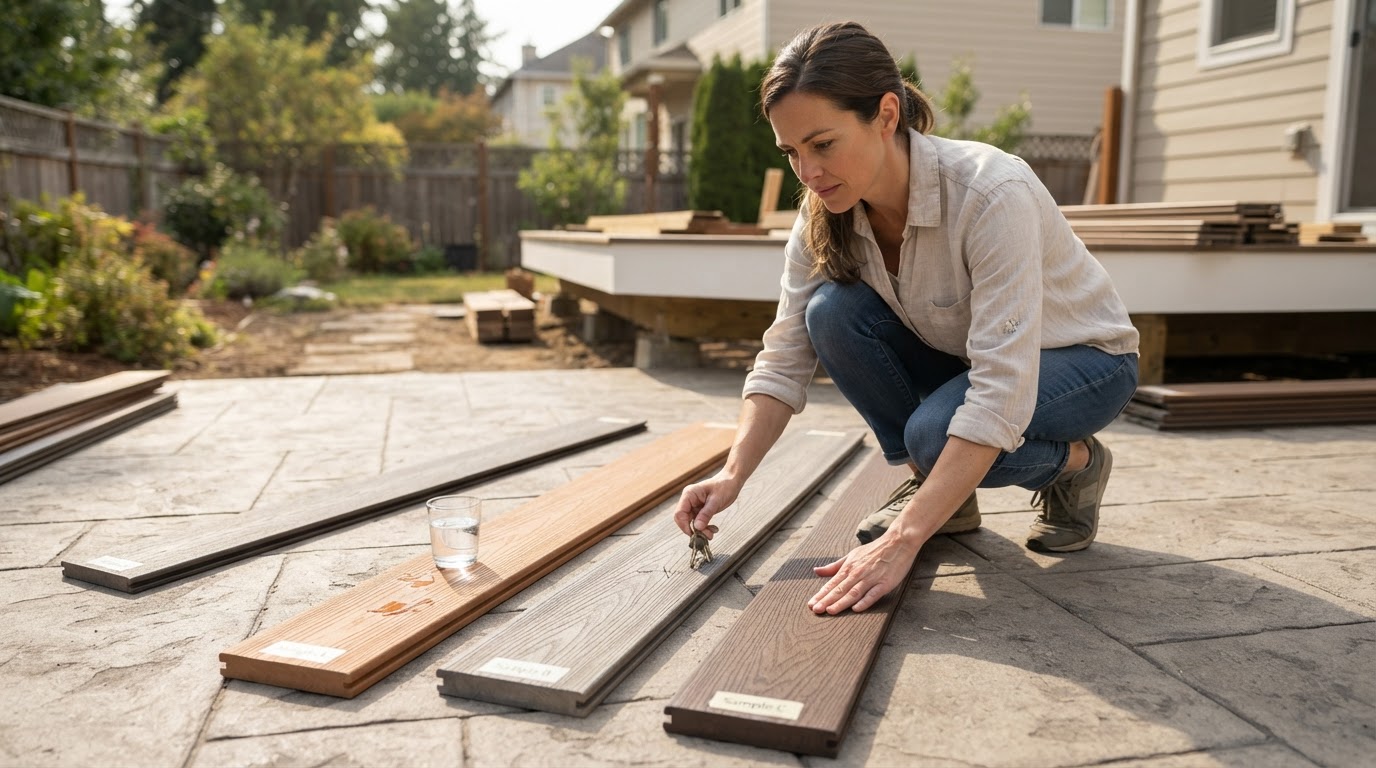
The material you choose splits the market again. Wood deck services (pressure-treated, cedar, or exotic hardwoods) usually cost less upfront and need periodic maintenance. Composite deck services (TimberTech, Trex, Fiberon, and similar lines) cost more but drop most staining and sealing. Concrete deck services and paver systems compete for at-grade patios where height and framing are not the issue. If you compare quotes across these categories, you are not comparing deck services yet, you are comparing different products.
Write down the exact job you want before you call anyone. "Repair or replace" is not a scope; "replace 16 boards, tighten the railing, and re-flash the ledger" is.
Step 1: Verify the Company Before You Talk Price
Price is the last thing to compare, because a low number from an uninsured company is not a lower price. It is a transferred risk.

Licensing. Ask for the license number, verify it with your state or local licensing authority, and make sure the category covers decks. Some states license general contractors, others register specialty trades, and some local jurisdictions issue their own permits and registration. The number belongs in the written contract, not just on a business card.
Insurance. Request a certificate of insurance and confirm it with the insurer or agent, not just the copy the salesperson carries. You want general liability coverage and a clear answer about how injuries on your property are covered, including workers' compensation where the law requires it. If the company cannot produce a current certificate, stop.
Bonding. Some states and cities require a surety bond or a recovery fund for licensed contractors. If yours does, check that the bond is active.
Track record. Ask for three projects from the last 12 to 18 months that are similar in height, material, and access to yours. Then call the homeowners and ask what went wrong. Every project has something.
Certifications. Composite and railing warranties sometimes depend on installation by a certified or trained contractor. Check the manufacturer's installer directory rather than trusting a logo on a truck.
Reviews. Read the one-, two-, and three-star reviews for patterns such as scheduling drift, surprise change orders, and cleanup problems, instead of trusting the average score. When you search "deck builders near me" or "deck contractors near me," remember that paid placement is not a credential.
Step 2: Pressure-Test the Construction Plan
The gap between a deck that lasts 25 years and one that fails in five is usually structural, and it hides after the first season of rain. Deck construction is governed by the International Residential Code in most U.S. jurisdictions, and the American Wood Council's DCA 6 prescriptive deck construction guide translates that code into the details contractors should be able to explain.
Ask each bidder to walk you through four things:
- How the deck attaches to your house. The ledger board and its flashing are the most common water-intrusion point. The code requires flashing where decks attach to a wood-frame wall, and continuous flashing is the standard detail.
- How the deck resists lateral movement. Decks must be anchored to resist sideways loads. Hold-down tension devices or an approved engineered connection are the usual answers; "it's bolted to the house" is not a plan.
- How the guard meets load requirements. Required guards must resist a 200-pound concentrated load applied in any direction, and guard openings must not let a 4-inch diameter sphere pass through. Ask what connector hardware the railing posts use, because toe-screwed balusters are not the same thing.
- How the footings and fasteners are sized. Footings are sized to soil bearing capacity and to the load above them. Fasteners and connectors in treated lumber must be corrosion-resistant or hot-dip galvanized, and stainless steel is the usual choice near salt water. Smooth-shank nails can back out with moisture cycling, so the fastener type matters.
Two limits are worth knowing before you compare quotes. The DCA 6 prescriptive tables apply to single-level residential wood decks; multi-level decks, hot tubs, planters, and other concentrated loads are outside that scope and need design by a licensed professional. If your project includes any of those, ask for the stamped plan or an engineering letter, and expect the cost to appear in the bid.
Step 3: Compare Itemized Quotes, Not Bottom Lines
A per-square-foot price is the most misleading number in the deck business. Two bids can show the same dollars per square foot while one includes composite decking, aluminum railing, and stairs and the other includes none of them. Height also changes the real cost: taller decks need larger footings, longer posts, more framing, and more railing, so the same footprint can cost far more at 10 feet than at 2 feet.
Ask every bidder for the same itemized breakdown, and make them use the same line items:
- Labor and supervision
- Decking material, with brand, product line, color, and square footage
- Framing lumber, with species, grade, and treatment
- Footings, with size, depth, and concrete
- Posts, beams, and structural connectors
- Fasteners and hardware, with type and coating
- Railing, with material, height, and baluster spacing
- Stairs and landings
- Flashing and waterproofing details
- Permits and inspection fees
- Demolition, hauling, and site protection
- Lighting, staining, or other finish work
Build a one-page worksheet with those rows and one column per bid, then mark each cell Included, Excluded, or Unclear. Send a short written list of follow-up questions for every Unclear cell. This is the step that turns a deck services comparison from a vibe check into arithmetic.

Published pricing from local companies helps you sanity-check the range. Deck Bros, a family-owned Omaha-area contractor, states it is licensed, bonded, and insured in Nebraska and Iowa and publishes past-project pricing, including a 12x12 composite replacement at $16,000 and a 24x12 resurface at $18,000. That is the kind of concrete reference point that makes a percentage difference between bids meaningful.

Mid-page pricing section with real case study: composite deck replacement at $44,426 (20x16x5, Fiberon Sanctuary, Westbury railing). Ideal for composite vs wood cost articles.
Finally, look at how each bid handles payments. A schedule tied to completed milestones keeps leverage in your hands; a large deposit before any work starts moves it to the contractor. Hold the final payment until the punch list is finished and the inspection has passed.
Step 4: The Pre-Signing Question Checklist
Get written answers to all of these before you sign. If a bidder will not put an answer in writing, treat it as a no.
- Scope - What exactly is included, and what is explicitly excluded? Size, height, shape, stairs, railing, and finish.
- Materials - Which brand and product line, which color, which framing species and grade, and which treatment?
- Permits - Who pulls the permit, who pays the fee, and who attends the inspections? Will you receive copies?
- Timeline - What is the start date and the completion window, and what happens if weather or material delays push it?
- Payment schedule - What is the deposit, which milestones trigger each payment, and when is the final payment due?
- Change orders - How are changes priced and approved? Written change orders signed before work, or verbal adjustments afterward?
- Warranty - How many years of workmanship coverage, what does it exclude, and will the manufacturer warranty be registered in your name?
- Insurance - Will you receive a current certificate of insurance before the first day on site?
- Demolition and cleanup - Who removes the old deck, hauls debris, and protects landscaping and siding?
- Crew and subcontractors - Who performs framing, railing, and any electrical work, and are they licensed and insured?
- Completion standard - Who walks the punch list with you, and what defines "done"?
- Payment documentation - How will you confirm that suppliers and crews have been paid, so no lien lands on your property?
Step 5: Green Flags and Red Flags
Green flags cluster around transparency: an itemized bid you did not have to beg for, a license number printed on the contract, a certificate of insurance your agent confirms, references from similar projects, a permit pulled in the contractor's name, and warranty terms in writing.
Red flags cluster around pressure and vagueness: cash-only terms or a large upfront deposit, "we don't need a permit for this," a bid delivered by text with no site visit or measurements, refusal to name the decking product or railing brand, no physical business address, and a discount that expires today. Any one flag might have an innocent explanation. Two or more, and you should keep collecting bids.
Step 6: Your Completion Standard - The Go/No-Go File
Stop shopping when your file is complete, not when the price feels right. Before you sign, you should be able to assemble all ten of these items:
- License number verified with the licensing authority and recorded
- Certificate of insurance confirmed with the insurer or agent
- Three comparable references contacted, with notes on what each homeowner said
- One itemized bid per contractor, all using the same line items
- Written scope with exclusions spelled out
- Permit responsibility confirmed in writing
- Payment schedule tied to milestones, with the final payment after punch list completion
- Written change-order process
- Workmanship and manufacturer warranty documents
- Written answers to every question in the checklist above
If a line is empty, the comparison is not finished. That is the finish line for choosing deck services: not the lowest quote, but the bid you can explain, document, and hold someone to.