What the Price per Square Foot Leaves Out
When a contractor quotes a deck replacement cost per square foot, they are usually pricing the decking surface — not the entire project. Two quotes can show the same unit rate and still land thousands of dollars apart, because the number underneath covers different work.
A useful way to picture it: the per-square-foot rate prices the part you can see, while the scope statement prices everything that has to happen before and after the boards go down. Demolition, haul-away, framing repair, stairs, railing, fascia, and permits all sit outside a simple area calculation.
That is why the same square footage can produce a low rate and a high final invoice. Before you compare numbers, compare what each number includes.
The Cost Drivers That Move the Unit Price
Use the list below as a checklist when you read a quote. Each row changes either how much material the job needs or how much labor the crew spends per square foot.
Cost driver | Why it changes the number | What to ask |
|---|---|---|
Deck size and shape | Small or cut-up footprints spread the same mobilization, design, and permit overhead across fewer square feet, so the unit cost often rises. | Is the rate quoted on total area or usable area? |
Decking material | Material cost, fastener system, and expected maintenance differ by product and product line. | Which exact product line and color is priced? |
Height and structure | Elevated decks need more framing, bracing, stairs, and fall protection, which adds labor below the surface. | Is the substructure priced separately? |
Stairs and railing | These are usually quoted by linear foot or by unit, not by deck area. | How many linear feet of railing and how many steps? |
Demolition and disposal | Tearing out old boards, railings, and posts and hauling them away adds labor plus dump fees. | Is tear-out and disposal included, and who pays the dump fee? |
Framing condition | Sound joists and ledger boards may be reused; rot, improper spacing, or failed connections force structural work. | Was the framing inspected, and what did it find? |
Site access | A fenced backyard, a steep slope, or a narrow gate slows material handling. | Are there access charges or equipment needs? |
Permits and inspections | Structural changes and some replacements require permits and inspection time. | Who pulls the permit, and is the fee in the quote? |
If a quote lists only one rate and a total, ask for the line items above. A contractor who can break them out is showing you where your money goes.
Wood or Composite: Comparing the Two Main Replacement Paths
Most replacement decisions come down to decking material, because the material drives both the upfront rate and the maintenance you sign up for. Compare the two options on the same four criteria: upfront cost, maintenance, appearance, and how each behaves when the decking goes over an existing frame.
Pressure-treated wood decking is usually the lower upfront option per square foot, but it needs regular cleaning and resealing and stays vulnerable to moisture and freeze-thaw movement.
Composite decking carries a higher upfront cost per square foot, and in exchange it needs less routine maintenance and avoids the annual staining cycle.
On appearance, wood gives you natural grain and the ability to refinish or re-stain later; composite gives you consistent color and a wider range of finishes, but the color you choose is essentially the color you keep. On an existing frame, both can be installed over sound framing, but board weight, fastener spacing, and joist requirements differ, so the framing has to be checked before either product is priced.
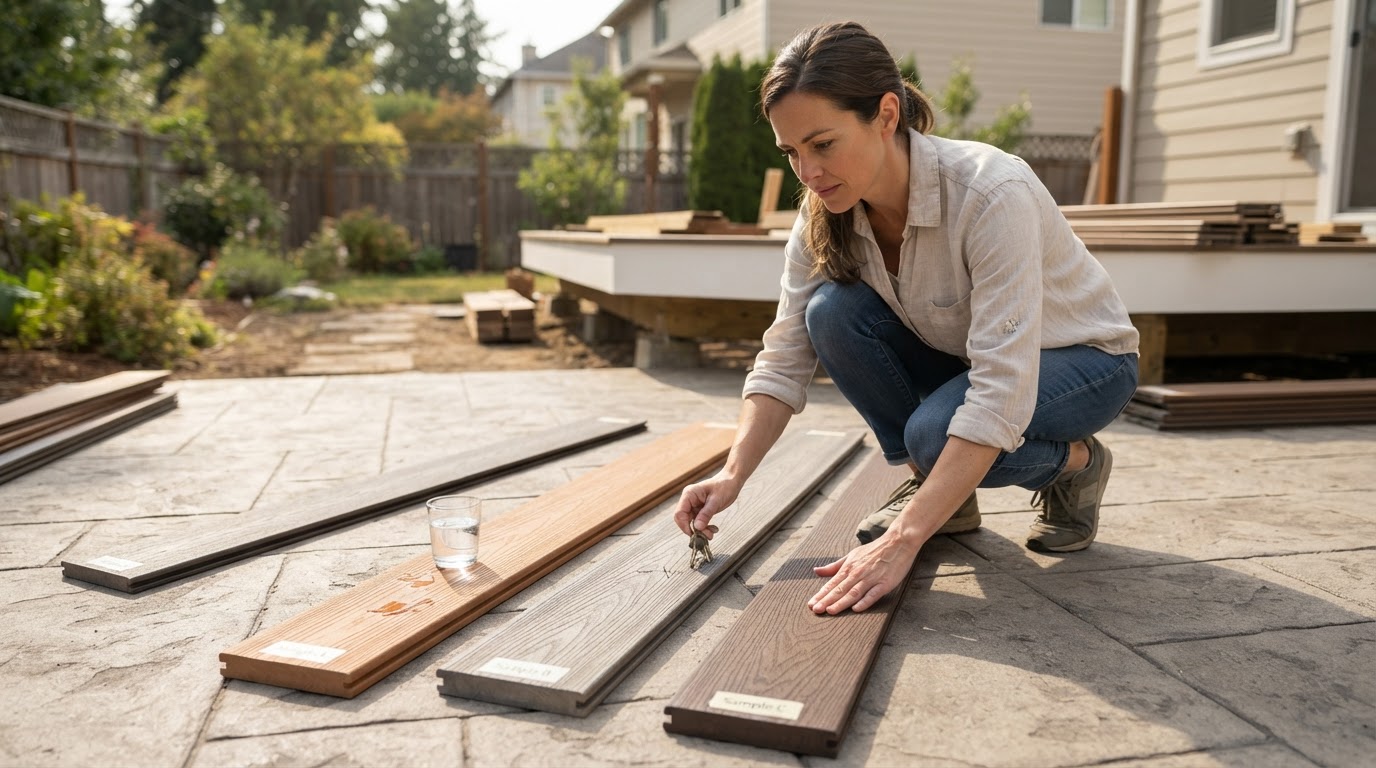
Neither option is the right answer for every household. If you plan to stay for decades and would rather not spend weekends on upkeep, composite usually fits. If upfront cost matters most and you do not mind an annual maintenance routine, wood can be the practical choice. Ask for samples and look at both in daylight before you decide.
Resurface or Rebuild? Start With the Deck You Have
The deck you are replacing is the baseline for the whole decision. A deck with soft boards, loose railings, or a spongy feel is telling you something about more than the surface.
Two conditions usually push a replacement rather than a repair: the framing is no longer trustworthy, or the repair bill approaches the cost of new decking anyway. Rusted or undersized fasteners, rot at the ledger board where the deck meets the house, cracked joists, and posts that move when you push on them are structural signals. A professional inspection can confirm what is cosmetic and what is not.
If the framing is sound, resurfacing — installing new decking over the existing structure — can be the faster and less expensive path. Stairs, blocking, and joist reinforcement may still be needed. If the framing is compromised, a full rebuild is the honest option, and the project shifts from a surface replacement to a construction job with new footings and framing.
The switching cost is where budgets surprise people. A resurface keeps the old footprint, so demolition is limited to the boards and railing. A rebuild adds tear-out of the structure, disposal of more material, new concrete work, and inspection steps. Ask for both scenarios priced separately so you can see what the extra scope buys.
How to Read Published Benchmarks Responsibly
Published per-square-foot figures are useful for one thing: they give you a range to sanity-check a quote. They are not a promise, and they rarely cover identical scope.
When you see a rate online, look for three pieces of context:
- What is included: decking only, or decking plus railing, stairs, fascia, and disposal?
- Which material and product line: a pressure-treated board and a premium composite cap are not the same purchase.
- Where and when: material prices, labor rates, and permit rules differ by market.
Then apply the rate to your own deck dimensions, add the line items from your scope, and treat the result as an estimate with a range — not a fixed price.
What to Compare in Every Quote
Put two or three written quotes side by side and compare them on the same ten points:
- Total square footage and how it was measured.
- Decking product, brand, and color, with the model number.
- Framing inspection results and any repairs included.
- Demolition scope and whether dump fees are covered.
- Stairs, railing, fascia, and trim — by quantity.
- Permits and inspections, and who is responsible.
- Fasteners and hidden hardware, including corrosion protection.
- Timeline, crew size, and weather contingency.
- Warranty terms for labor and for the material.
- Payment schedule and what happens if the scope changes.
A quote that answers all ten points is comparable. A quote that answers three is a starting point for a conversation, not a decision.
A Local Example: What Deck Bros Publishes
This guide is published by Deck Bros, a family-owned deck contractor in the Omaha area.
According to its published project information, Deck Bros installs new decking over existing framing, handles stairs, blocking, and joist reinforcement, and reports most resurfacing jobs are finished within a working day.
The company's published install pricing lists wood decking at $9.74 to $12.43 per square foot, and its documented replacement projects include a 12-by-12-foot composite replacement at $16,000, a 24-by-12-foot resurface at $18,000, and a complete elevated replacement at $65,500. Deck Bros also publishes that it is licensed, bonded, and insured in Nebraska and Iowa, serves the Omaha metro, the Lincoln area, and nearby western Iowa communities, and offers same-day phone estimates.
Use those figures the way you would use any published benchmark: as a reference point when you compare your own quotes. A local inspection of your deck's framing and access is what turns a published rate into a real number for your project.
Common Follow-Up Questions
Does a bigger deck always cost less per square foot?
Not always. Fixed costs such as mobilization, design time, and permits spread across more square feet, which can lower the unit rate, but a complex shape, a second level, or difficult access can push it back up. Size is only one input.
Can I keep my existing railing and stairs?
Sometimes. If the railing posts and stairs are structurally sound and match the new decking, they can stay. If they are loose, rusted, or out of code, replacing them is usually part of the replacement scope. Ask for both options priced.
Do I need a permit to replace decking?
It depends on the scope and your local building department. Resurfacing that keeps the existing structure may not require one; structural changes, new footings, and some railing work usually do. Confirm in writing who is pulling the permit before work starts.
How long does a replacement take?
It depends on scope. Deck Bros reports that most resurfacing jobs are finished within a working day, while builds from the ground up take around three days. Demolition, inspections, and weather can extend either timeline.
What is the best way to use a per-square-foot number?
Treat it as a benchmark, not a quote. Multiply it by your deck area, then adjust for material, framing work, railing, stairs, disposal, and permits. The final range you build that way is what you compare against real written estimates.