Deck replacement cost: the short answer
This guide is published by the team at Deck Bros, a family-owned deck contractor serving the Omaha metro, Lincoln, and nearby communities in Nebraska and Western Iowa. Because the publisher is a deck contractor, every figure below is tied to published project pricing and labeled as a local benchmark rather than a national average.
Replacing a deck is not a single line item. It is the sum of tear-out and disposal, whatever the frame underneath needs, the decking material you choose, railing and stairs, and the labor to assemble it. You are paying for a build plus a teardown, so the same deck costs more to replace than it would have cost to build in the first place.
To make that concrete, Deck Bros publishes wood decking installed over an existing structure at roughly $9.74 to $12.43 per square foot. That published rate covers decking work on an existing structure — new boards, stairs, blocking, and joist reinforcement — not a full structural rebuild. Published project examples from the same source show how much scope changes the total: a 12×12 composite replacement at $16,000, a 24×12 resurfacing at $18,000, and a complete elevated replacement at $65,500.

Mid-page pricing section with real case study: composite deck replacement at $44,426 (20x16x5, Fiberon Sanctuary, Westbury railing). Ideal for composite vs wood cost articles.
Read those numbers as a sanity check, not a quote. Per-square-foot rates and project totals measure different scopes, which is why they never line up directly. Material prices, labor rates, tear-out difficulty, and permit rules all move by market, so the same 12×12 deck can land at very different totals in two towns.
What's inside a deck replacement quote
A complete estimate should account for six areas of work. Walk through this list before you compare bids, because a low number usually means something is missing rather than something is cheap.
Tear-out and disposal
Removing the old deck is real labor: pulling boards, cutting out fasteners, and hauling everything away. Treated and composite decking is heavy and does not compact, so disposal is a line item of its own. If the old deck has rot, insect damage, or fasteners that strip and spin, tear-out takes longer, and that time shows up in the labor line.
Framing and substructure
Once the boards are off, the frame decides the scope. A sound frame may need only minor repairs, new flashing, or replacement fasteners. A frame with rot at the ledger board, soft joists, or failed footings needs structural work before new decking makes sense. This check is the biggest fork in a replacement budget, and it cannot be done from a photo — someone needs to look underneath.
Decking material
Wood and composite sit at different points on the cost curve. Pressure-treated lumber costs less up front; it also needs staining or sealing on a schedule and can splinter as it ages. Composite boards cost more, then ask for little beyond soap and water. Cedar and hardwood fall between those poles, each with its own maintenance habits and lifespan. The right answer depends on how long you plan to stay, how much upkeep you want, and how the deck gets used.
Railing, stairs, and detail work
Railing is priced by the linear foot, and it needs posts, brackets, and careful alignment, so it carries real weight in a replacement budget. Stairs add stringers, treads, and often a landing. Fascia, skirting, lighting, and built-in seating each add scope. These are the easiest items to remove from a quote and the hardest to add later without paying for a second mobilization.
Labor, permits, and scheduling
Labor reflects crew size, how accessible the yard is, how high the deck sits, and how much custom detail the design includes. Permits and inspections apply in most jurisdictions whenever the structure changes, and your contractor should know the local rules and pull the paperwork. Spring and early summer fill contractor calendars first, so schedule flexibility can be worth as much as a small price difference.
Wood versus composite: the trade-off that moves the total
Material choice is the decision homeowners revisit most often, because it is the part of the project they can see and touch every day. The honest comparison is not just price; it is price plus the maintenance you are willing to do.
What you are weighing | Wood | Composite |
|---|---|---|
Up-front material cost | Lower | Higher |
Maintenance | Staining or sealing on a schedule | Occasional cleaning |
Look and feel | Natural grain that warms in the sun, can splinter | Uniform color, cooler underfoot |
Best fit | Tighter budgets and homeowners who enjoy upkeep | Households that want to stop thinking about the deck |
Treat the table as directional, not as a quote. Your estimate depends on the specific products, the frame work underneath, and the features you add, and those can move a total further than the board choice does.
Repair or replace? A five-point checklist
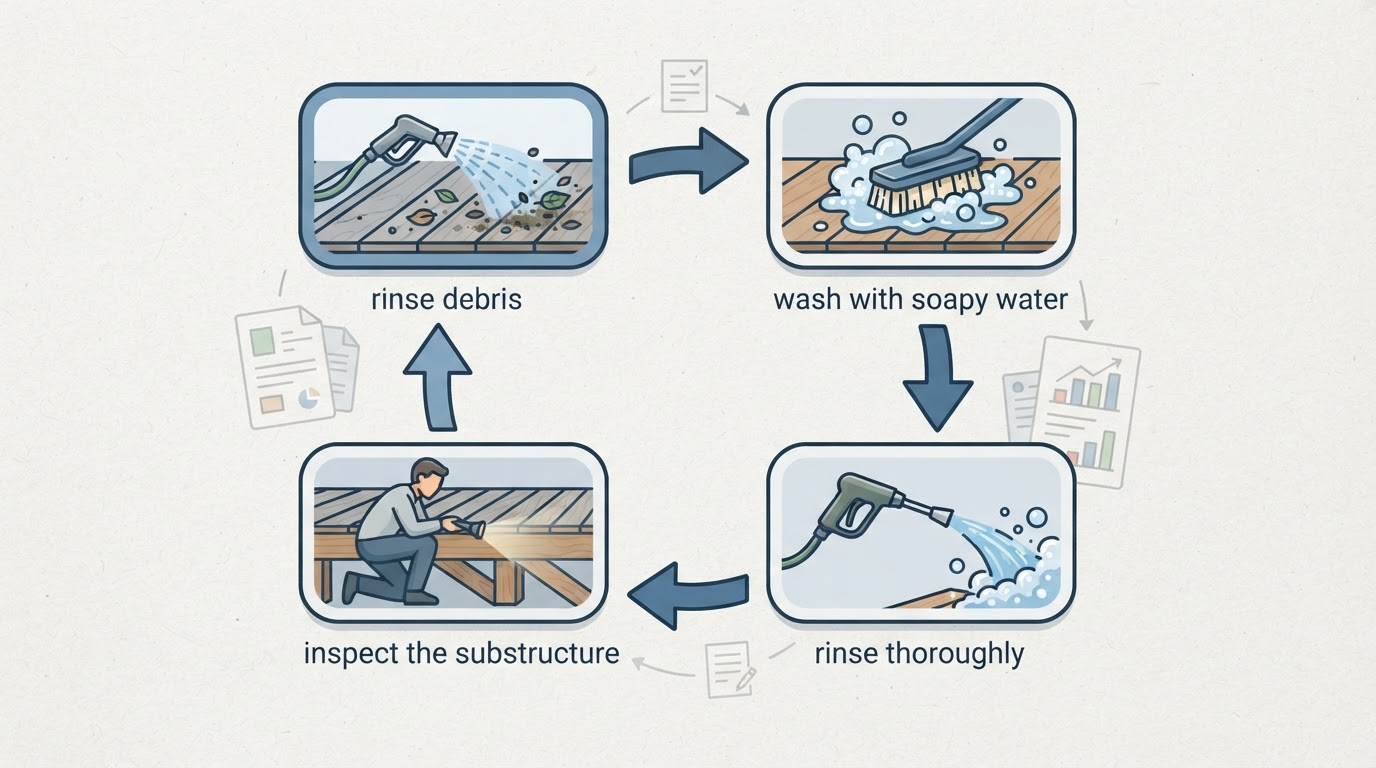
Sizing up your own deck before you call anyone helps you ask better questions and spot an upsell. Grab a flashlight and work from the ground up.
- The ledger board and flashing. Where the deck meets the house, look for loose or rusted fasteners, gaps, and staining that suggests water has been getting behind the siding. This connection carries much of the deck's load.
- The joists and beams. Soft spots, sagging, or cracking all point to rot. If a screwdriver sinks in easily, that lumber has lost strength and cannot safely hold new decking.
- The posts and footings. Check for shifting, heaving, or footings that no longer sit properly in the ground. Frost movement is common across Nebraska and Iowa, and it rarely corrects itself.
- The railing. Push on it. Railing that flexes, pulls away from the posts, or has loose balusters is a safety problem, not a cosmetic one.
- The board surface. Cupping, splintering, popped nails, and widespread soft spots mean the decking is finished. A few isolated bad boards are a repair; half the surface is a replacement.
If the frame passes and the boards are the only problem, resurfacing — new decking over the existing structure — is often the better value. If the frame fails, you are looking at a rebuild, and the decking choice becomes a smaller share of a bigger decision. When a repair quote starts closing in on a replacement quote, patchwork rarely pays off, because each repair resets the clock on only one part of the deck.
DIY deck replacement versus hiring a contractor
DIY deck replacement can save the labor share of the budget, but it asks you to handle tear-out, disposal, permits, and any framing surprises on your own. You buy the materials, rent or borrow the tools, schedule the inspections, and live with the result.
The math is not only about cash. DIY trades a contractor's labor rate for your weekends, your tools, and your risk tolerance. Add up tool rental, disposal fees, and the value of your time before you assume doing it yourself is cheaper; a project that drags into a second month often costs more than the quote you turned down.
On the other side, a full-service contractor brings the crew, the tools, the disposal, the permit paperwork, and a warranty. You pay for that coordination, and in exchange you get a build that is scheduled, inspected, and covered if something goes wrong. The right call comes down to how the deck sits on your property, how much time you have, and how confident you are in the framing underneath.
How estimates and consultations work
A deck replacement estimate starts with a visit or a detailed phone conversation. Someone needs your deck's dimensions, a clear look at the existing frame, and a sense of what you want to keep or change. From there, a contractor can measure, note access constraints, and price the scope line by line.
Before the visit, gather three things: rough dimensions of the current deck, photos taken from underneath if you can get them, and a short list of what you want the new deck to do — more room for seating, less maintenance, safer stairs, or a layout that fits how your household actually uses the space. If you already have a target budget, share it. A good contractor will tell you what it buys instead of quietly designing past it.
When you compare written estimates, put them side by side and confirm each one covers:
- Tear-out and disposal of the old deck and decking
- Inspection and any repair or replacement of framing, footings, and the ledger connection
- Decking material, product line, and the square footage it covers
- Railing, stairs, fascia, and any lighting or seating
- Permit fees, inspection responsibility, and who schedules them
- Timeline, payment schedule, and warranty terms
List items with no price, vague allowances, and "we will see when we open it up" are the first places a quote hides its risk. Ask what happens if the frame needs more work than the estimate assumed, and get that answer in writing before you sign.
Deck Bros publishes same-day response, phone estimates, and licensing, bonding, and insurance in Nebraska and Iowa; ask any contractor you consider for the same proof.
Common questions about deck replacement cost
Is it cheaper to replace a deck or build a new one?
A new build avoids the tear-out and disposal work, so a like-for-like replacement usually carries the extra cost of removal. The gap narrows when the old deck comes apart quickly and the frame can be reused, and it widens when the frame needs rebuilding or the site is hard to reach.
Can I replace only the deck boards?
Yes, if the frame underneath is sound. Resurfacing — installing new decking over the existing structure — is one of the best-value options in deck work. It depends entirely on what the framing looks like once the old boards are off, so have the frame inspected before you buy materials.
How long does a deck replacement take?
Decking work on a sound frame can move quickly, while a full rebuild takes longer because tear-out, framing, inspections, and material lead times stack up. Weather and permit queues matter in the Midwest, where the building season is short. Deck Bros publishes that decking installed over an existing structure is typically finished within a working day, while from-ground-up builds run around three days; ask each contractor how tear-out and inspections affect their timeline for your deck.
Does composite cost more than wood?
Composite decking generally costs more up front than pressure-treated lumber, and it usually needs far less maintenance over time. Wood can be the better value if you keep up with staining and sealing; composite can win if you would rather not think about it. Either way, the installed total depends as much on the frame and features as it does on the board.
Do I need a permit to replace a deck?
Often yes, especially when the structure, footprint, or railing changes. Rules vary by city and county, and some jurisdictions treat a like-for-like resurfacing differently from a structural rebuild. Ask who pulls the permit and who schedules the inspection, then confirm the answer with your local building department before work starts.
How can I lower the cost without cutting corners?
Reuse the frame if it is sound, keep the footprint and layout close to the original, choose a simpler railing profile, and schedule in the off-season if your contractor offers flexibility. Do not skip the framing inspection, drop the permit, or accept a quote with no written scope. Those shortcuts tend to cost more later.
How to get a number you can trust
Every figure in this guide is a benchmark, not a quote. Deck replacement cost depends on your deck, your site, your market, and the scope you choose, and nobody can price those things from a distance. Get two or three written estimates that itemize the same line items, ask what happens if the frame needs more work, and compare the answers before you compare the totals.
One last check: make sure each estimate names the decking product, the railing, the disposal, the permit, and the warranty. When the scopes match, the price difference means something. When they do not, you are comparing two different decks.