Repair or Replace? Start With Where the Damage Lives
One rule separates a repair that holds from money thrown at a deck that cannot be saved: surface parts are replaceable, but the frame carries the load, and once it is soft, no amount of new decking fixes it.
Think of the deck as two systems. The visible system — boards, stair treads, railing sections — is designed to wear out and can be swapped. The hidden system — joists, beams, posts, footings, and the ledger board that ties the deck to the house — carries everything you put on it. A deck with a sound, dry frame is a repair candidate almost regardless of age. A deck with a rotten frame, a compromised ledger, or heaving footings is a rebuild candidate even when the boards still look decent.
Age matters less than most homeowners expect. A 30-year-old deck with dry framing and working drainage can take a full surface replacement. A 12-year-old deck that has been leaking at the house can be structurally finished. Water, not the calendar, decides.
What Usually Fails on a 15–35-Year-Old Wood Deck
Cedar and pressure-treated decks in a freeze-thaw climate like eastern Nebraska and western Iowa fail in a predictable order:
- Surface boards. Cupping, checking, splinters, popped fasteners, and soft spots around nail and screw holes. Boards usually go first because they take the sun, the rain, and the foot traffic.
- The ledger board and flashing. The ledger is bolted to the house rim, and the flashing above it is supposed to divert water. When flashing fails or was never installed, water runs behind the ledger and rot starts where you cannot see it.
- Joist tops and hangers. Water that slips between boards sits on the top edge of the joists. Rusted hangers and dark, soft wood at a joist's top edge are the classic signs.
- Posts at grade. Wood in ground contact rots first at the soil line, and older decks sometimes set posts directly in soil with no footing or a small one.
- Stairs. Stringers sit close to the ground, collect moisture, and rot from the bottom up. A stair that moves underfoot has usually lost its attachment or its stringer.
- Railings. A railing that wobbles is rarely just a loose bolt. The usual cause is rot in the post base or in the framing the post bolts into.
- Fasteners. Corroded or undersized fasteners let the deck work itself loose, which opens gaps for more water.
Notice the pattern: every failure starts with water and ends with structural wood.
What a Deck Repair Can Usually Fix
When the damage is local and the surrounding wood is sound, these repairs are standard and reliable:
- Boards. A single damaged board, a bad run along a doorway, or the whole surface. Replacing decking over a dry, solid frame — sometimes called resurfacing — is the highest-value repair on an older deck.
- Stairs. New treads and risers, a rebuilt landing, or a single replaced stringer when the others are solid.
- Railings. New balusters, a new section, or a new post when the frame it attaches to is dry and holds a fastener.
- Joists. Sistering a limited number of joists — fastening a new joist alongside a damaged one to share the load — reinforcing a soft section, or replacing a few hangers is practical when the rot is isolated.
- Cosmetic and preventive work. Cleaning, sealing or staining, tightening and replacing hardware, and correcting the drainage that caused the problem in the first place.
The common thread: a repair is only as good as the wood around it. If the wood next to the repair is soft, the repair moves the problem rather than solving it.
When Replacement Is the Safer, Better-Value Call
Replacement is the honest answer when the damage is not local, when the load path is compromised, or when safety is in question. Watch for these:
- Rot at the ledger board or where the deck meets the house, especially with failed flashing. This is the connection that keeps the deck from pulling away, and it is not a place for patchwork.
- Soft wood in several joists, a beam, or the rim and band board — not one or two members.
- Posts rotted at grade or footings that have heaved, cracked, or were never sized for the deck. In a freeze-thaw climate, ongoing movement keeps opening the wood to water.
- The deck moves, sags, or leans, or the stairs have pulled away from the frame. Movement is a symptom of a structural problem, not a cosmetic one.
- Failures keep appearing. When you fix one area and find another every season, the frame is telling you its service life is over.
- The guards and stairs cannot be made safe without rebuilding most of the frame — for example, posts too small or too far apart to hold a proper guard.
- The deck has gone decades without maintenance and the surface and framing are both due. Once you are paying to remove the surface, putting it back on a spent frame is the expensive version of the job.
One trigger by itself is a conversation. Three or four together are a decision.
The Five Questions That Settle the Repair-or-Replace Call
Before you price anything, answer these in order:
- Where does the rot stop? Surface only means repair. Joists mean a closer look. Ledger, beams, footings, or multiple posts mean rebuild.
- Is the ledger dry and firmly attached? If there is any doubt about the house connection, stop planning cosmetic work and get it evaluated.
- Do the posts and footings carry the load without movement? Push and watch for flex at the base, not at the rail.
- How much service life do you actually need? If you plan to stay 15 years, the frame has to last 15 years. If you are selling next spring, a safe, tidy repair may be the right scope.
- How many times do you want to pay for access? Replacing decking means removing and reinstalling the surface. If the frame fails two years later, that labor is paid twice.

The fifth question is the one homeowners underestimate. The cost of a deck project is not only materials; it is the work of getting to the parts that failed. A slightly larger repair now is often cheaper than a second opening later.
A 15-Minute Inspection You Can Do Yourself
Do this in daylight, starting at the ground. If the deck feels bouncy, moves when you walk on it, or shows rot where it meets the house, keep people off and have it assessed before you use it again.
- Walk the surface. Look for cupped boards, popped nails, and dark patches. Probe suspect boards with a screwdriver near fasteners and along edges; soft wood gives way instead of resisting.
- Get under it if you can. From below, check joist tops, hanger condition, and the underside of the ledger. Water stains and crumbling wood are the finding you are looking for.
- Inspect the ledger and flashing. Where the deck meets the house, look for staining, soft wood, and flashing that has pulled away or was never installed.
- Probe the posts at grade. Push a screwdriver into the post just above the soil line. If it sinks easily, the post is failing at its most loaded point.
- Shake the railing. Movement at the post base points to rot in the attachment or the framing behind it.
- Check the stairs. Look where the stringers meet the ground, and stand on each tread to feel for movement.
- Follow the water. Note downspouts that discharge near the deck, debris packed between boards or along the ledger, and planters that hold soil against wood.

Photograph each finding and mark its location. A contractor can quote from a clear set of photos and one visit instead of guessing.
Match the Repair to the Deck's Age
Age is a rough filter, not a verdict:
- 15–20 years. Most problems are still surface-level. Board replacement, stair treads, and railing work usually hold for years when the frame is dry.
- 20–30 years. Expect the first structural repairs. A joist or two, a stair stringer, and hanger replacement are common; the ledger deserves a close look.
- 30–35+ years. Results split. A dry, well-built frame can still accept new decking, but original untreated framing, in-ground posts, or decades of minor leaks usually point to a full rebuild.
In all three ranges, maintenance history and water control matter more than the build year.
Repair vs Replace: How the Two Paths Compare
Decision area | Repair usually wins when | Replacement usually wins when |
|---|---|---|
Surface boards | The frame is dry and solid | Surface and framing are both due |
Stairs | Treads, risers, or one stringer | Several stringers, landing, or footings are failing |
Railings | Framing at the posts is solid | Post bases or framing are rotted |
Joists | One or two members or hangers | Several joists, beams, or the band board are affected |
Ledger and house connection | Dry, flashed, and firmly attached | Any rot or failed flashing |
Time and disruption | The deck stays usable with limited downtime | You would pay for the same tear-down twice |
Long-term cost | Localized damage and low maintenance | Repairs keep returning each season |
Safety and code | Existing guards and stairs are sound | Guards or stairs need a rebuild to be safe |
Count how many rows land in the right-hand column. One or two is a repair with attention; four or more is a rebuild conversation.
What a Professional Assessment Adds
A contractor assessment should answer three questions in plain language: is the deck safe to use right now, where does the rot stop, and is repair or replacement the better value? The inspection has to include the parts you cannot see from the surface — ledger attachment, flashing, joist tops, hanger condition, and post bases at grade.
Deck Bros, a family-owned deck contractor that works across the Omaha metro, the Lincoln area, and western Iowa, is one example of a local team that offers a free on-site condition assessment with a repair cost estimate, along with a safety evaluation that answers the question most homeowners are really asking: is this deck still safe to use? Deck Bros reports more than 300 deck repairs across the Omaha metro, and its assessment includes guidance on whether to repair or rebuild. The company works with homeowners in Papillion, La Vista, Bellevue, Gretna, and Chalco, reaches the Waverly area near Lincoln, and covers western Iowa communities including Council Bluffs, Glenwood, and Missouri Valley.

Deck Repair landing page hero section showing repair services (stairs, railing, resurfacing, painting, staining) and call-to-action.
Common Mistakes That Make Repairs Fail
- Replacing boards over rot. New decking on a soft joist gives you a season or two before the same spot fails again.
- Tightening instead of inspecting. A wobbling rail post usually means the wood holding it is rotten; a bigger bolt does not fix soft wood.
- Skipping the ledger. Cosmetic work on a deck with a wet, unflashed ledger is work in the wrong place.
- Wrong fasteners. Deck screws hold boards; they are not a substitute for the structural fasteners that connect framing, hangers, and the ledger.
- Covering soft wood. Paint and stain hide rot for a season and hold moisture against it after that.
- Leaving the water source in place. If the downspout, the debris, or the planter keeps feeding the deck, the repair is temporary by design.
- Chasing symptoms. Fixing one soft board every spring is a sign to inspect the frame, not to buy more boards.
Maintenance That Keeps a Repaired Deck Healthy
- Clear debris from between boards, around posts, and along the ledger after storms and in the fall.
- Re-coat wood finishes before the surface dries and opens. The right cadence depends on the product, the sun exposure, and the finish, so check the deck each spring rather than following a fixed number of years.
- Check railings, stairs, and fasteners once a year and tighten or replace as needed.
- Move planters and soil away from posts and the ledger; keep mulch and dirt from holding moisture against wood.
- Direct downspouts and runoff away from the deck edge and the house connection.
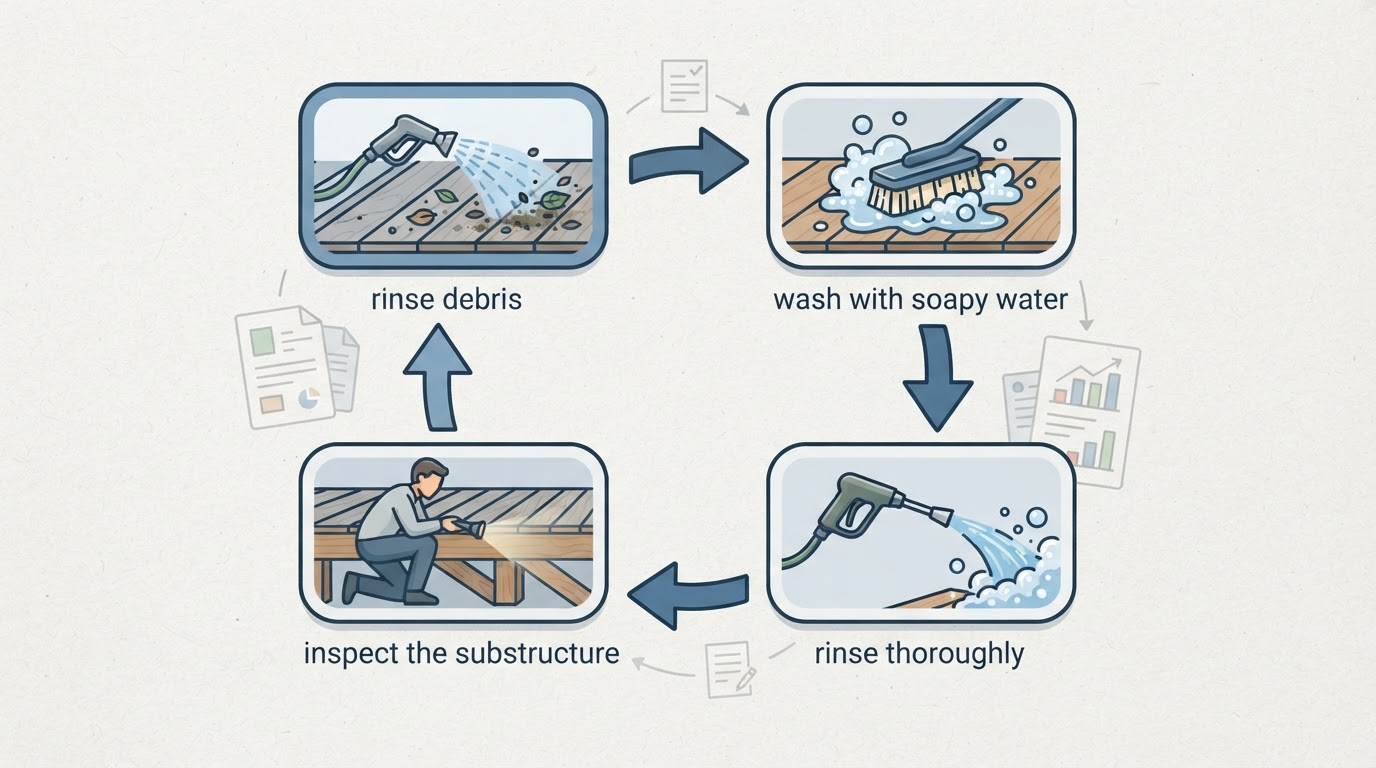
- Shovel snow with a plastic shovel and avoid aggressive pressure washing, which can raise the grain and drive water into the wood.
A deck that stays dry and gets small repairs early is the one that stays repairable.
Common Questions Homeowners Ask
Can a deck with a rotting frame be repaired? Sometimes. Isolated joist rot can be sistered, and a single rotten post can be replaced when its footing and beam are sound. Once rot reaches several joists, beams, the band board, or the house connection, a rebuilt frame is usually the safer and better-value path.
How long do deck repairs last? As long as the cause is fixed. A board replaced over a dry joist can last the life of the deck; the same board over a leak or a rotten ledger will fail again.
Is repair cheaper than replacement? For localized damage, yes — and by a wide margin. The gap closes as the scope grows, because the labor to open up the deck gets paid either way. If you repeat that labor, the repair stops being the cheaper option.
Can a replacement reuse the existing footings? Often, yes. When footings pass inspection, a rebuild can keep the same footprint and reduce the work. When they have heaved or were undersized, reusing them just moves the old problem into the new deck.
Do deck repairs need a permit? Structural work and most full replacements require a permit in many jurisdictions. Ask before work starts, and ask whether the contractor pulls it for you.
What can I repair myself? Replacing a board, tightening hardware, cleaning, and sealing are realistic DIY work. Anything involving joists, posts, footings, or the ledger is structural, and mistakes there are both expensive and unsafe.
How do I know a repair will hold? Ask what happens to water and what supports the repair: correct flashing and drainage, sound framing around the repair, and the right fasteners. A plan that only describes the visible board is incomplete.
Turn Your Inspection Into a Repair Plan
Start with the five questions, then count the rows in the table. If the rot is surface-level and the frame is dry, plan the repair, fix the water source, and expect it to hold. If the rot reaches the skeleton, price a rebuild against the cost of repeated repairs — and remember that the new deck comes with a frame that starts its life dry.
Either way, one professional assessment is worth more than a season of guesswork. Deck Bros offers a free on-site condition assessment and repair estimate across the Omaha metro, the Lincoln area, and western Iowa, so the repair-or-replace question gets answered with the deck in front of you instead of a photo on a phone.