Why Some Decks Age Faster Than Others
Two decks can look identical the summer they are built and nothing alike a decade later. The difference usually isn't luck. It is water, movement, and the construction decisions that control both.
Water finds every gap. A deck is a stack of joints — where posts meet footings, where the ledger meets the house, where joists meet hangers — and every joint either sheds water or holds it. Wood that stays wet through repeated freeze-thaw cycles breaks down far faster than wood that dries between storms. In the Omaha area, that cycle repeats all winter, which is why deck problems here tend to show up at the bottom of posts, at the ledger board, and at the cut ends of decking boards.
Movement matters just as much. A deck that flexes underfoot works its fasteners loose. Loose fasteners open gaps. Gaps let in water. A handful of construction choices drives most of that cycle:
- Footings and posts. Posts that sit in soil or stand on undersized footings stay damp and shift with the freeze-thaw cycle.
- Ledger flashing. The ledger is where the deck ties into the house. If the flashing above it is missing or has failed, water runs behind the board and into the rim joist — a hidden failure that can get expensive.
- Framing and connections. Undersized joists, missing hardware, or a beam bolted to the side of a post instead of bearing on it all create the movement that starts the decay cycle.
- Fasteners. The wrong metal in treated lumber corrodes quickly, and corroded hardware stops holding anything tight.
- The surface. Decking boards shield the frame from sun and rain, but they also decide how quickly water drains away. Tight joints and trapped debris keep the frame wet.
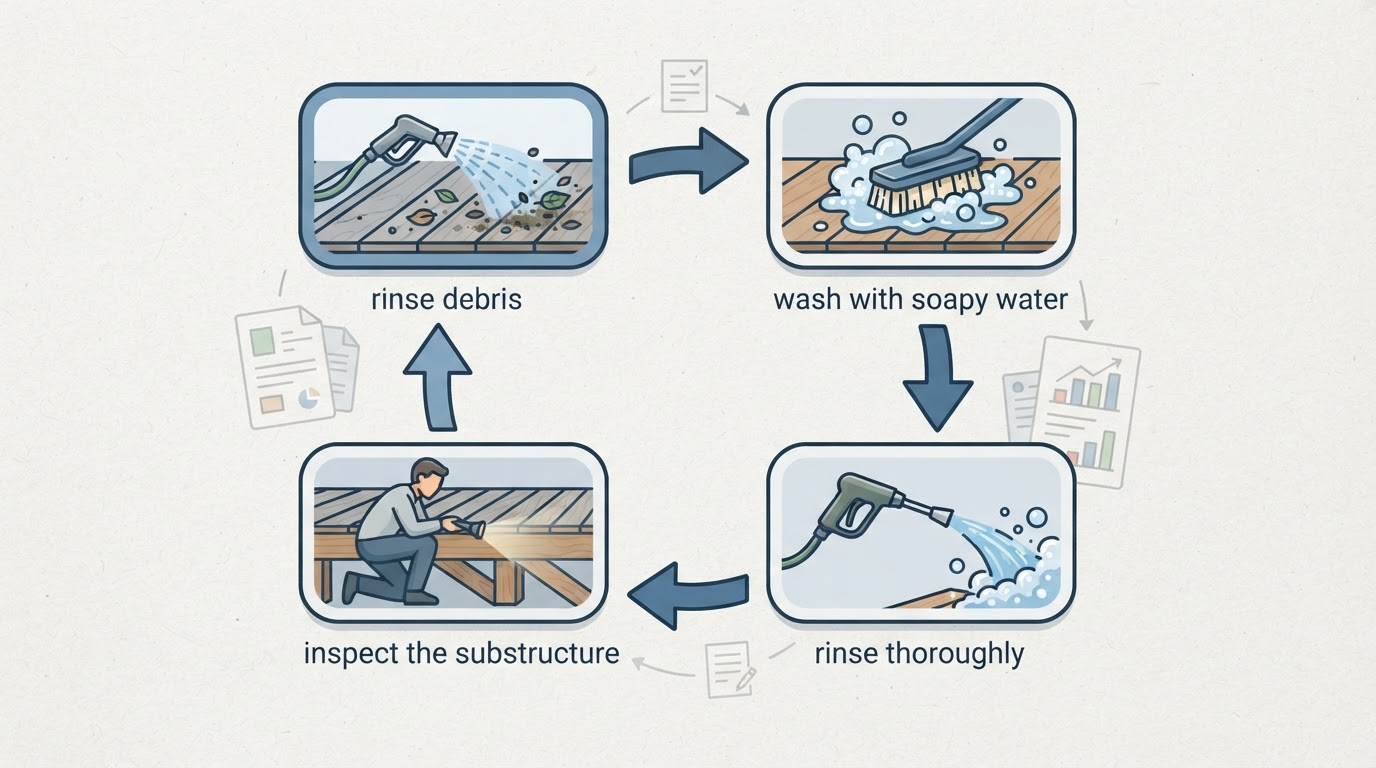
- Maintenance. Staining, sealing, and clearing debris slow the process. They can't fix a structural flaw.
How to Inspect an Aging Deck: A Component-by-Component Check
Plan on 20 minutes, a flashlight, and a flathead screwdriver, and start underneath the deck. Work from the ground up and check the structure before the surface, because that is the order in which failures usually travel.

One safety rule first: if the deck moves when you step on it, if you can see a gap between the house and the ledger, or if a post is visibly rotting, keep people and furniture off it and have it assessed before you crawl underneath. You can inspect a lot from the sides and the top without putting yourself under a questionable structure.
Start With the Ground and the Posts
Walk the perimeter and look at the base of every accessible post. You are looking for wood that stays wet: posts set directly in soil, posts standing in planters or mulch, and posts with dark, soft wood at the bottom. Probe the bottom few inches of each post with light pressure — sound wood resists, decayed wood gives. Then check the footing itself: cracks, a post that is out of plumb, or soil that has pulled away from the concrete all point to movement.
While you are down there, look at drainage. Soil piled above the bottom of the frame, downspouts that empty under the deck, or water that stands after a storm will keep the framing wet no matter how well it was built.
Check the Connection to the House
The ledger board attaches the deck to the house framing, and it is the most important connection on the deck. Look above it for a metal flashing that tucks under the siding and laps over the top edge of the ledger. If the flashing is missing, corroded, or pulled away, water is heading directly into the wood behind it.
Then look for symptoms: a dark stain under the siding, a gap that opens between the ledger and the house, rust streaks from the bolts, or white and black fungal growth. Have someone stand on the deck while you watch the ledger — if the gap moves, that is a structural red flag, not a maintenance item.
Inspect the Framing and Hardware
Under the deck, check the joists, the beam, and the connections between them:
- Joist hangers should be complete, with every specified fastener in place. Look for empty holes, rust, or splitting wood around the fasteners.
- Joist and beam ends near the house are the first places rot starts. Dark, soft, or crumbling wood there usually means water has been getting in for a while.
- Beam-to-post connections should transfer the load directly. A beam that bears on top of a post or in a proper notch is correct; a beam bolted to the side of a post, or a deeply notched post, is a detail worth confirming with a professional.
- Lateral connectors — diagonal bracing or metal ties that keep the deck from swaying side to side — are often missing on older decks.
- Bounce and spring are symptoms, not personality. A deck that feels bouncy underfoot usually has an undersized member or a loose connection somewhere.
Probe the Decking Surface
On top, look for the obvious: cracked, splintered, or gray boards; nail heads standing proud; boards pulling away from the joists. Probe the suspect spots with light pressure, especially at board ends and anywhere you see dark streaks or stains. Rot tends to start at cut ends and in the shade near the house, so those areas deserve a closer look. Composite decking doesn't decay like wood, but it can crack, fade, or loosen at the fasteners, and the wood framing under it can still rot.
Test the Railings and Stairs
Grab the guardrail and push and pull it firmly. It should feel solid. A railing that shifts is one of the most common safety failures on an aging deck, and it is usually caused by guard posts that are fastened to the decking or rim instead of through-bolted to the frame. Residential guards are typically at least 36 inches high, with baluster spacing tight enough that a 4-inch sphere can't pass through; your local code has the exact requirement.
On the stairs, check that treads are tight, stringers are solid, and the handrail is continuous. Pay attention to where the stringers meet the ground, since that is another spot where moisture collects. Then look at the stair framing underneath, if you can reach it safely.
What the Symptoms Usually Mean
What you see | Likely cause | What to do |
|---|---|---|
Wobbly or loose guardrail | Guard posts attached to the deck surface instead of the frame; loose fasteners | Keep people away from the rail until it is repaired |
Gap between the ledger and the house, or stains below the siding | Missing or failed ledger flashing; rot in the rim or ledger | Treat it as structural; get an on-site assessment |
Soft spots in decking, especially at board ends | End-grain moisture and decay | Replace the board and check the framing under it |
Crumbling wood at the bottom of a post | Soil contact or a footing that keeps the post wet | Have the post and footing evaluated |
Bouncy, springy deck | Undersized joists, an excessive span, or loose hangers | Professional assessment before heavy use |
Sagging stairs | Decayed or undersized stringers | Repair or replace the stairs |
Dark staining around joist ends or hangers | Chronic moisture and early decay | Probe, monitor, and plan the repair |
What Modern Deck Construction Gets Right
Reliable deck construction comes down to two habits: building one continuous load path from the deck surface to the ground, and keeping water out of every joint along the way.
Each choice — footing, post, beam, joist, ledger, decking, and guard — is part of one continuous load path, and every joint in that path has to stay tight and dry.

Footings and Posts
A footing is the concrete base that transfers the deck's weight into the soil. It should be sized for the load it carries and extend below the local frost depth, so the freeze-thaw cycle can't lift it and move everything above it. Posts should be rated for ground contact and hold their end grain above the concrete on a standoff base rather than sitting in soil. They should also be anchored to the footing with approved hardware so they can't slide or lift.
Framing and Connections
Joists are sized and spaced for their span, then connected to the ledger and beam with hangers and connectors engineered for the load. The details that matter most:
- Joists sized and spaced to meet the decking manufacturer's requirements and local code, with blocking wherever the plans call for it.
- Beams that bear directly on posts, with approved connectors.
- Lateral hardware or bracing that resists side-to-side movement.
- A ledger that is properly fastened and flashed, because it transfers a large share of the deck's weight to the house.
- Fasteners matched to the lumber. Modern treated wood is corrosive to some metals, so hot-dip galvanized, stainless, or manufacturer-approved coated fasteners are the safe choice.
Decking Materials
Wood decking — pressure-treated, cedar, or an exotic hardwood — is repairable, familiar, and available at every price point, but it needs periodic cleaning and re-staining, and it can splinter. Composite decking skips most of that routine, resists splinters and rot in the boards themselves, and typically carries long manufacturer warranties, but it costs more up front, can get hot in full sun, and performs best over a dry, well-ventilated frame. Whichever surface you choose, the frame underneath is usually wood, and it is the part that decides how long the deck lasts.
Drainage and Ventilation
Good deck construction assumes water will get in and gives it a way out. That means a slight slope away from the house, decking gaps that stay clear of debris, downspouts that discharge well away from the frame, and enough air movement under the deck that wet framing dries between storms. Stairs, planters, or skirting that trap moisture against the frame work against everything above them.
Repair, Resurface, or Rebuild?
Once you know what is failing, the decision usually falls into one of three buckets:
- Repair makes sense when the damage is limited and accessible: a few rotted boards, a loose rail section, a worn stair tread, and framing that is otherwise sound.
- Resurface — new decking over the existing frame — works when the surface is the worn part but the joists, beam, posts, and ledger are sound. It is faster and less expensive than a rebuild, and it can modernize a deck's look. Two cautions: installing composite over framing that doesn't meet the manufacturer's requirements can void the warranty, and resurfacing over hidden rot simply traps it.
- Rebuild is the honest answer when the problems are structural: failed footings or posts, a rotted ledger or rim joist, widespread framing decay, or connections that were never built correctly in the first place. A rebuild is also worth considering when the deck's size or layout no longer fits how you use the yard.
The hard part is that the most expensive problems are the ones you can't see. A deck can look fine from above while the ledger, rim joist, and post bottoms are quietly failing. The deeper the wear goes beyond the surface, the more a professional on-site assessment is worth compared with guessing from a photo.
That is the kind of call a contractor makes on site. Deck Bros, a family-owned deck contractor that serves the Omaha metro, Lincoln area, and Western Iowa, offers a free on-site condition assessment that includes a safety evaluation and a repair estimate, and the company reports more than 300 deck repairs across the Omaha area. If you are weighing repair against a rebuild, that kind of inspection gives you a factual starting point instead of a guess.

Deck Repair landing page hero section showing repair services (stairs, railing, resurfacing, painting, staining) and call-to-action.
If the deck is moving, though, don't wait for an appointment. Keep people off it and treat the assessment as urgent.
Questions Homeowners Ask Before Deciding
How long should a wood deck last?
There is no single number, because construction, drainage, maintenance, and climate all pull on the answer. A deck with deep footings, a flashed ledger, and good ventilation can stay serviceable for decades; a deck with water traps can fail far sooner. Age alone is a poor guide. Condition is what matters.
Can I install composite decking over my existing frame?
Sometimes. The framing has to be structurally sound, correctly spaced for the new decking, and compatible with the manufacturer's installation requirements. The ledger, flashing, and ventilation also have to be right. If the frame is questionable, resurfacing hides the problem instead of solving it.
Does composite decking rot?
The boards themselves resist rot much better than wood, but most composite decks sit on a wood frame. Moisture around that frame is still the real risk, especially where boards and hidden fasteners trap debris. Keeping the frame dry matters just as much with composite as it does with wood.
Do I need a permit to repair or rebuild a deck?
It depends on the scope and where you live. Replacing structural members or building a new deck commonly requires a permit and inspections, while minor repairs often do not. Check with your local building department before work starts, and confirm that whoever does the work will pull the permits that are required.
What should I ask a contractor?
Ask how footings will be sized and how deep they will go, how the ledger will be flashed, what fasteners and hardware will be used, and whether the existing frame is sound enough to keep. Ask for the warranty terms in writing, the permit responsibility, and references from similar projects. Those questions tell you more about the quality of the work than any photo gallery.
Where to Start This Weekend
Take a flashlight and walk your deck from the ground up: post bases first, then the ledger, then the framing, the decking, and finally the railings and stairs. Write down anything that is soft, loose, stained, or moving. If the list is short and cosmetic, you have time to plan a repair or a resurface. If you find movement, rot at the ledger or the post bases, or a loose guardrail, get a professional assessment before the deck carries a crowd.