Quick answer: when a paid chore app may be worth considering
A paid tier earns its keep when a specific, observable limit blocks the way your household already runs. The usual triggers are narrow:
- A second adult, or a child, needs their own view of the same plan.
- Chores rotate, and the reassignment step keeps failing.
- Reminders and change notifications matter more than the list itself.
- You need completion records to answer questions about who did what.
- Ads, member caps or missing exports make the free tier a dead end.
One trigger on its own is rarely enough. Two or more is a reasonable signal to test a paid tier for a week instead of arguing about it.
Start with the household problem, not the subscription
Write the problem in one sentence before you open a pricing page: who assigns the chores, who can see them, how many people are involved, how often they repeat, and what fails today. A visibility problem looks like tasks that were assigned but never seen. A motivation problem looks like a plan everyone understands and ignores. An app addresses the first; it rarely fixes the second, because a chore app makes work visible, not appealing.
Two related workflows sit outside this page: dividing chores fairly in the first place, and helping children check off their own shared chores. If either is still unsolved, settle it first. This article is about whether to pay for the next tier, and it deliberately does not repeat the setup steps for those workflows.
Free vs paid chore-app comparison criteria
Compare every app against the same criteria, and score your household rather than the software. The table below describes what each tier usually changes; confirm each app's specific limits on its official pricing page before you rely on them.
Criterion | What free tiers usually give you | What paid tiers usually change | Upgrade is justified when |
|---|---|---|---|
People and devices | One person's view, one device | Every member gets a view, synced across devices | A second adult or a child must act on the plan |
Recurring chores and rotation | A repeating task | Rotation, fairness views, automatic reassignment | Rotation is the step that keeps failing |
Reminders | A basic notification | More reminders, change alerts, due windows | Missed reminders cause real-world problems |
Permissions | Everyone edits, or only you can | Roles, approvals, limited child accounts | Younger children need a restricted view |
Records | Current items only | Completion history and reports | You need to show what was done and when |
Rewards | Points inside the app | Reward store, allowance ledger, approvals | Points are already part of your routine |
Exports and recovery | Little or no export | Text or CSV export, backup, restore | You do not want your planning locked in |
Ads and support | Ads, self-service help | Ad-free experience, priority support | Ads or slow support cost you real time |
Member, device and shared-access limits
Member limits decide more upgrades than any feature list. Tody keeps a single-person cleaning plan free forever with no ads, then charges $9.99 a year for Premium and from $25 a year for Premium+ tiers that add household sync and FairShare. In practice, if two people need to see the same live plan, the free tier does not cover it.
Cozi keeps a shared calendar, shared to-do lists, shopping lists and a recipe library free for every family member, while its $39-a-year Gold tier removes ads and adds a mobile month view, calendar search, up to three reminders per event, change notifications and a birthday tracker. There, the first sharing step is already free, and the paid tier sells convenience rather than access.
This guide is published by the team behind Proxium, so the Proxium example below is a first-party illustration rather than an independent review. Proxium is a UK household app that is free to download with core features included, while its Pro upgrade is a one-time £9.99 purchase rather than a subscription, and family sharing across shopping, tasks and the calendar is part of that paid unlock. If a one-time purchase suits your household better than a recurring fee, check Proxium's own pages for the current tiers and trial terms.
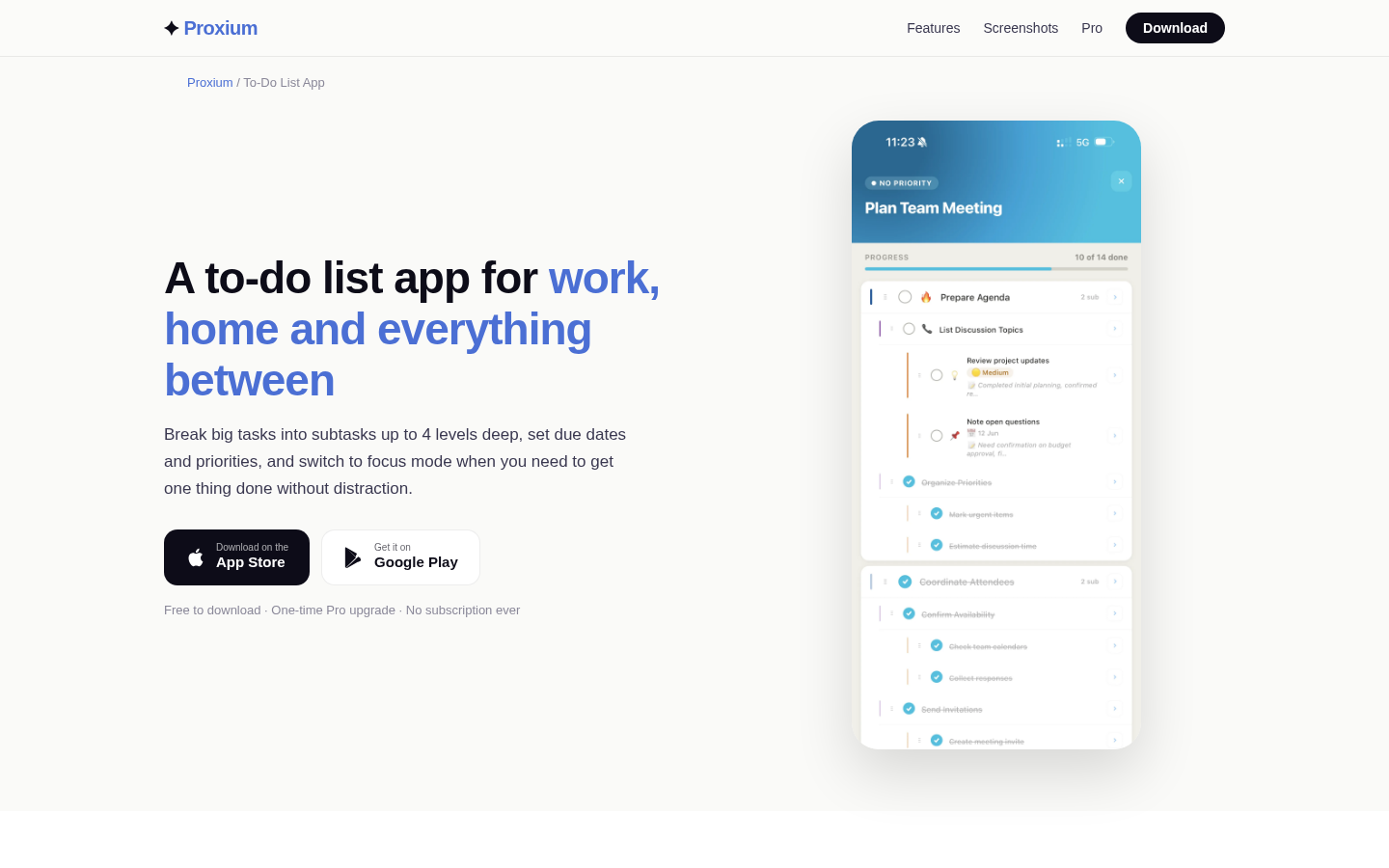
Feature landing page for to-do list app with subtasks, due dates, priority levels, and focus mode.
Recurring chores, rotations and reassignment
Rotation is where free tiers quietly differ. Tody, for example, lets you assign chores and rotate them automatically on every plan, including the free one, but the shared household view that makes rotation visible to everyone sits in the paid tiers. A shared to-do list, by contrast, may never rotate anything: it simply shows the same list to everyone, which is enough when the same person always does the same job.
Test rotation before you pay for it. Pick one chore with a real weekly cadence, rotate it between two people for one cycle, and watch where the handover breaks: the assignment, the notification, or the record. If the free tier handles the handover and only the reporting is missing, you may be buying the wrong thing.
Reminders, completion records and caregiver controls
Check three things on the free tier before you upgrade: how many reminders an item can carry, who can edit or complete it, and whether changes reach the other members. Cozi, for instance, lists extra reminders, calendar change notifications and a birthday tracker as part of its paid Gold tier rather than its free plan. Those are the features that separate a plan which updates itself from a plan someone has to re-explain every day.
Caregiver controls matter when more than one adult manages the household. Look for separate child views, approvals, and the ability to complete a chore without editing the underlying list. A household with two co-managers needs those controls more than it needs extra features.
Points, rewards and allowance-related features
Points are a record of effort, not money, and an in-app reward store is a motivation tool rather than a financial one. Decide what a point means in your household before a paid tier decides for you: some plans put the reward store behind the subscription, while others include points but keep approvals or leaderboards for paying members.
Two guardrails are worth keeping. First, do not treat points as currency in the app's favour: a point is a tally, and pocket money remains a separate conversation. Second, do not treat allowance features as financial advice. They are bookkeeping aids, useful for consistency and receipts, not for planning a household's finances.
History, reports, exports and account recovery
Free tiers usually show the current list, while paid tiers usually add history, statistics and reports. Ask what happens to completed chores: are they kept, and for how long? Can you export the record as text or CSV if you switch apps? Proxium, for example, lists data export among its Pro features. That question sounds bureaucratic until the week you want to leave.
Account recovery deserves the same early check. Confirm which sign-in methods exist, whether a purchase can be restored on a new device, and what happens to shared data when one member leaves the household group. A plan that cannot be recovered is a plan you will rebuild from memory.
A one-week test before upgrading
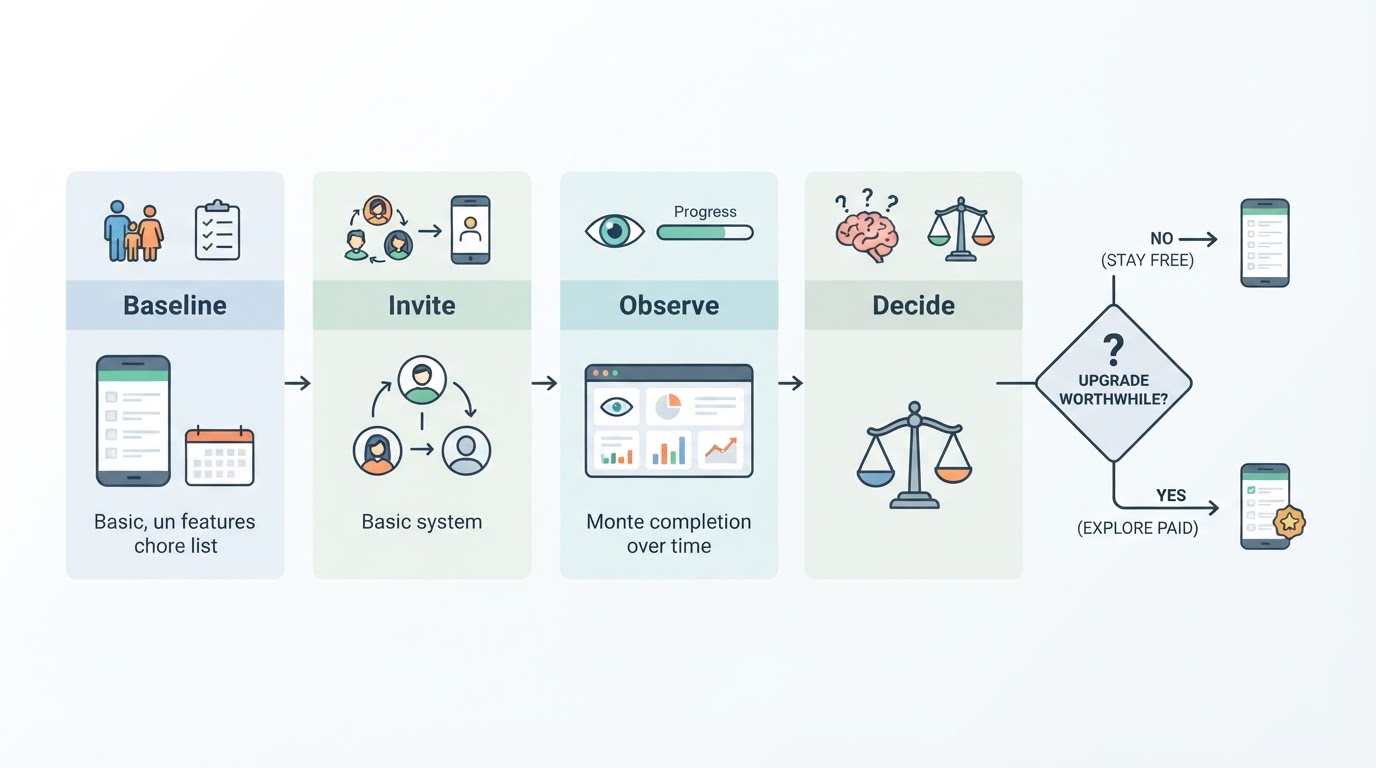
Do not decide from a pricing table; decide from one ordinary week. Run the test on the free tier, and start with a baseline.
- Baseline: write down how chores are assigned and tracked today, and where the current system failed in the past seven days.
- Invite one other member: the person who most often asks what to do, not the person who already manages everything.
- Observe for seven days: count missed reminders, reassignments and who-was-supposed-to-do-this conversations.
- Decide: hold the result against the criteria table, not against the subscription price.
Run the test for one full week, then compare the four checks against the baseline. If the free tier holds, keep it and revisit next term. If the same two or three checks fail every day, the upgrade has earned a trial.
Questions to check on the official pricing and support pages
Every product detail in this guide was checked against official pages on 17 September 2026, and prices, plan names and availability can change and differ by region and platform. The pages used here were Cozi's plan comparison, Tody's site and Proxium's official site; note that Cozi and Tody price in US dollars while Proxium prices in pounds sterling.
Before you pay, confirm on the app's own pages:
- Is the plan priced per household or per member?
- What is the billing cadence, is there a trial, and does it renew automatically?
- After the trial ends or you cancel, which features fall back to the free tier?
- Are ads removed, and are they removed for every member?
- Do child or guest accounts need their own paid seat?
- Can you export your data, and in which format?
- Which platforms and devices does one purchase cover?
- What does support cover, and how quickly?
Write the answers next to the criteria that triggered your upgrade. If the official pages do not answer a question, treat it as an unknown rather than a small-print detail.
When a shared list or manual chore chart is enough
A shared list is enough when the household is small, the chores are stable, one person administers the plan, and nothing rotates. A printable chart is enough when the work happens in one place at one time and the fridge door is the most visible screen in the house. A shared calendar is enough when the challenge is timing rather than tracking.
The honest test is the number of unanswered questions per week. If nobody asks who is doing what, you are already organized, and a subscription would mostly add administration. Upgrade when a named limit, not a general feeling, keeps producing the same question.
Final upgrade decision checklist
Work through the list and count the yes answers:
- Two or more people must act on the same live plan.
- The free tier caps members, devices or shared access below that number.
- Rotation or automatic reassignment is genuinely used in your household.
- Missed reminders cause real problems at least once a week.
- You need completion history, or an export you can keep.
- Ads or missing controls cost more time than the paid tier costs money.
- The one-week test showed the same failures without the paid features.
Two or more yes answers justify testing a paid tier. Fewer than two means the free tier, or a paper chart, is still the better tool for now. Either way, the decision should follow your household's constraints rather than the marketing page.